Bunts Road Rehabilitation Project

Current Traffic Impacts

  • Bunts Rd. is currently limited to southbound, one-way traffic between Madison and Lakewood Heights Blvd. This configuration is scheduled to be in place through December 15, 2026. There will be changes in which side of the street is being used as the travel lane to allow water, sewer, and road construction to occur on different sides of the road.
    • Northbound traffic is being detoured to Warren Rd.
  • Athens Ave. is closed at the Bunts Rd. intersection for staging of equipment and materials. This closure is expected to last through May 15, 2027.
An illustrated map of Bunts Road's traffic configuration, effective April 15.
Click to enlarge

Project Overview

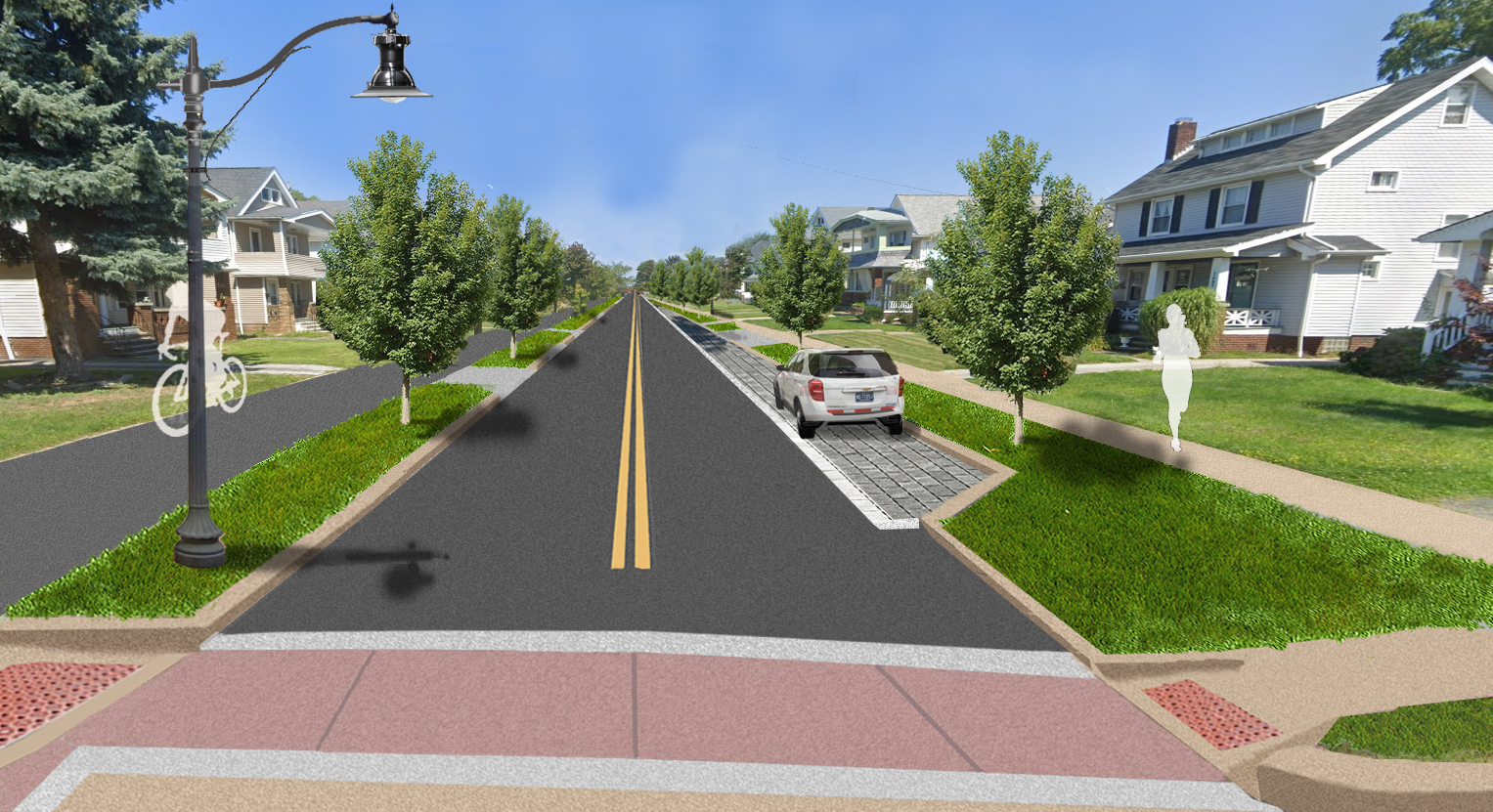
A rendering of Bunts Road depicting a new road surface, permeable parking lane, decorative lighting, and a shared use path on the west side of the street.

In 2026, the City of Lakewood will begin work on a complete roadway, sewer, and water rehabilitation of Bunts Road stretching from Lakewood Heights Boulevard to Clifton Boulevard. The project will be funded by NOACA Surface Transportation Block Grant (STBG) Program funds, the Ohio Department of Transportation (ODOT), and the City of Lakewood.

In alignment with Lakewood’s Integrated Wet Weather Improvement Plan (IWWIP), Bunts Road’s storm sewer system will be completely replaced to accommodate today’s standards. In addition, the watermain and city-side water supply lines spanning the length of Bunts Road will be replaced.

Bunts Road’s roadway, sidewalks, parking lane, and curbs will be redesigned to improve the safety of pedestrians, cyclists, and drivers alike. This portion of the project involves a replacement of the aging road surface, new curbs and storm drains, new sidewalks where necessary, and a new multipurpose path on the western side of the street. Additionally, new decorative streetlights will be installed with buried electrical lines to improve lighting and enhance the corridor’s visual appeal.

Project Updates

Below, you can find the Bunts Road project updates that are delivered via email to subscribers. If you would like to subscribe, click the button below.

Phase 1 Construction Presentation

The video below is an informational presentation on the construction of Phase 1 of the project.

Phase 1 stretches from Lakewood Heights Blvd. to Franklin Blvd, and is set to begin April 15, 2026. Phase 2 of the project will begin in 2027 after completion of Phase 1, and a separate presentation will be made available before Phase 2 work begins.

Addressing Resident Concerns About The Project

Will trees will be removed on Bunts for the Shared-Use Path?

The Bunts Road Project is primarily a roadway replacement project with complete water and sewer improvements. The sewer improvements are required by Lakewood’s agreement with the Federal Government.

Unfortunately, to install the new sewer line, trees must be removed on the west side of Bunts Road. This new sewer line requires an increase in the number of storm drains to accommodate storm water and meet current roadway design standards. Additionally, the installation of new water mains, gas lines, and other improvements may necessitate tree removal on both sides of the street.

For every project, the City of Lakewood goes to great lengths to preserve and protect trees, and is committed to maintaining and growing our urban canopy.

Upon completion of the project, tree lawns between Lakewood Heights Blvd. and Merl Ave. will be 6.5 to 7.5 feet wide, and between 11.5 to 12.5 feet wide from Merl Ave. to Clifton Blvd. All tree lawns will be able to support medium- to large-sized trees. The City plans to replace every tree that is removed, and plant additional trees throughout the Bunts Road corridor.

For this and every tree planting, our Forestry team members use their expertise to plant the right tree in the right place.

The shared-use path does follow the guidelines outlined in ODOT’s Multimodal Design Guide:

  • The path will feature a buffer on either side of at least 12 inches.
  • The path will be 10 feet wide, which matches the width of the paths used in the Cleveland Metroparks and on Detroit Avenue between Graber Ave. and Valley Parkway. A 10-foot width is within the Multimodal Design Guide specifications for shared-use paths in constrained environments.
  • The path cross-slope meets pedestrian accessibility guidelines, which is a maximum of 1.56 percent.
  • With an average daily traffic count of 7,800, Bunts Road qualifies as a “high-volume street” per the ODOT Traffic Engineering Manual. The FHWA’s Bikeway Selection Guide recommends shared use paths for roadways with this level of volume (see chart below).

A chart showing the recommendations for types of bike facilities based on traffic volume and vehicle speed. Areas with low volume and/or low speeds are white, and fade upward and outward to dark blue when speeds and volume are high. At low speeds, shared lanes or bike boulevards are recommended; at high speeds/volumes, separated bike lanes and shared use paths are recommended.

These concerns are addressed below:

  • Air Pollution: the shared-use path encourages alternative modes of transportation such as walking and biking to reduce air pollution. The PAHs and benzene in asphalt are short-term effects as a result of the improvements during construction. Further, the 6% decreased asphalt pavement area will reduce the overall health risks versus what is currently in place.
  • Higher Localized Temperatures: The increase in permeable area (22.5% upon completion versus 17.5% before construction) will reduce storm water run-off and heat island effects.
  • Green Space: The amount of green space will remain virtually the same with the addition of more trees and less impervious area thanks to the addition of permeable pavers and reduction in impervious pavement.

Project Changes Based on Public Comments

The following roadway design changes made after the Public Meeting/Comments period:

Parking Lanes

The parallel parking lane was changed to the east (northbound Bunts Road) side of the pavement between Lakewood Heights Boulevard and Madison Avenue, and from Franklin Boulevard to Clifton Boulevard. This places the parking lane on the opposite side of the Shared Use Path within those limits.

Between Madison Avenue and Franklin Boulevard (adjacent to Lakewood High School), the parking lane will remain on the west (southbound Bunts Road) side of the pavement. Since there are limited driveways on the west side in the block, this will provide the maximum amount of parallel parking spaces. In the area adjacent to the driveways to the High School, the parking will be prohibited as necessary to provide the required sight distance to bicycles and pedestrians on the Shared Use Path from drivers during into these drives.

Leading Pedestrian Intervals

Several comments were received to consider including Leading Pedestrian Intervals (LPI) in the signal timing for pedestrians and bicycles on Bunts Road. The LPI gives pedestrians the opportunity to enter the crosswalk at an intersection 3 to 7 seconds before vehicles are given the green light. This helps the pedestrians better establish their presence in the crosswalk before vehicles can proceed. During project design, the timing at all signalized intersections on Bunts Road (with the exception of Lakewood Heights Boulevard) will be reviewed to determine if an LPI can be included without affecting the overall operations of the intersection.

Left Turn Lanes

Left turn lanes in both north and south bound directions will be added to Bunts Road at Franklin Boulevard.

Sidewalk and Crossing Improvements Near Giant Eagle Parking Lot

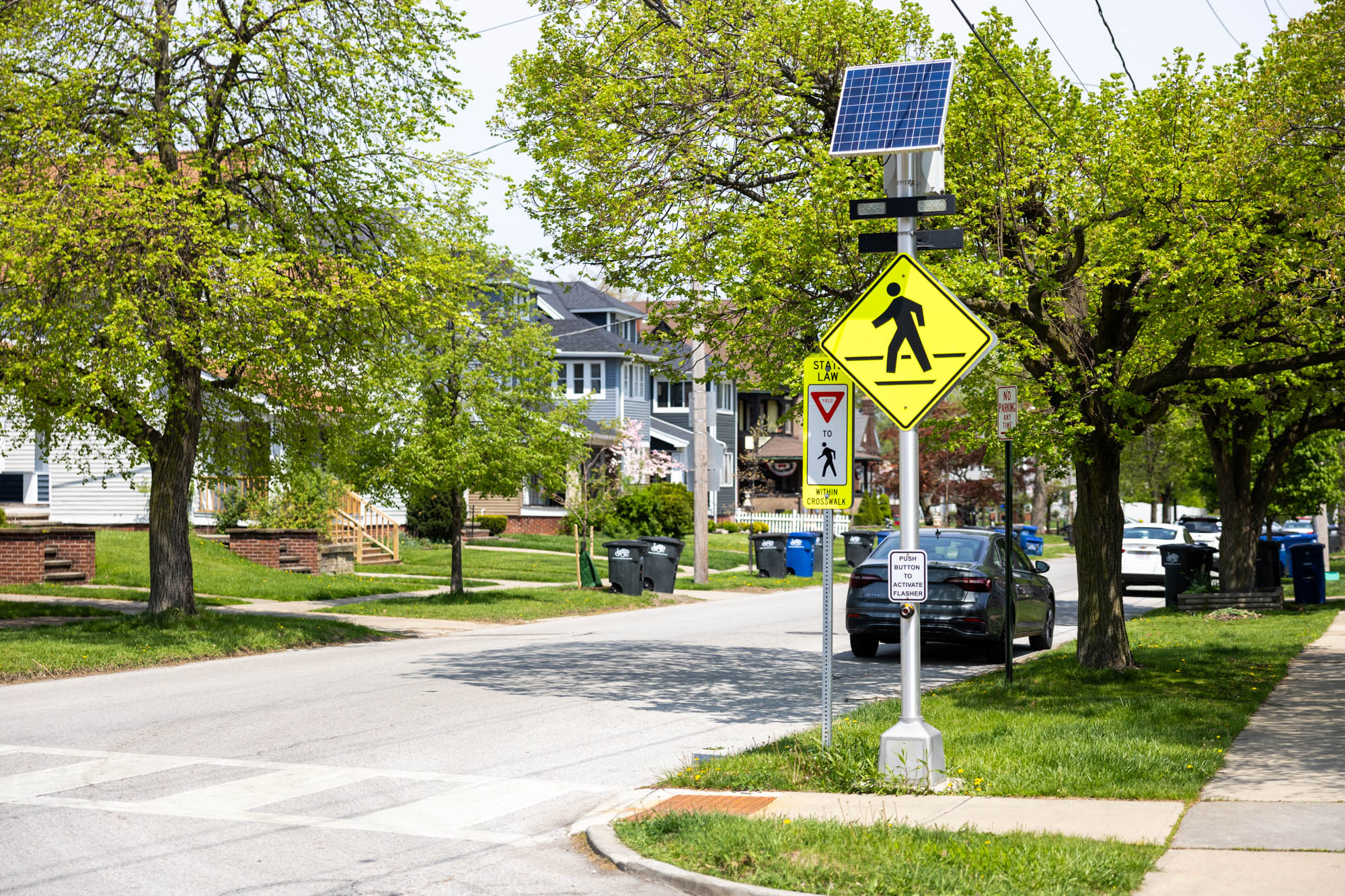
Rectangular Rapid Flashing Beacon located on Nicholson Ave. in Lakewood.

Communication has been started with representatives of Giant Eagle to address the driveways off Bunts Road. Improvements to these driveways will be made after these discussions.

Comments were received regarding the numerous pedestrians crossing Bunts south of the railroad tracks to access Giant Eagle and the safety concerns.  After further evaluation, a mid-block crossing with push button activated Rectangular Rapid Flashing Beacons (RRFBs) has been added to the plans south of the railroad tracks (in addition to the planned RRFB crossing at Merl Avenue).  The image to the right shows a photo of a typical push button-activated RRFB.

Permeable Pavers

The pavement for the parking lanes has been changed to permeable pavers. This change allows for: 1) a distinction between the traveling lane and parking lane; and, 2) a reduction in storm water runoff.

A new separate storm sewer system will collect all the impervious surface runoff from the entire project site.  The existing storm mains will only service the private properties.  This improvement greatly reduces the potential for private property flooding.

Curb Bump-Outs

Detroit Ave. curb bump-outs have been added at the northwest and southeast corners of Detroit and Bunts to reduce the crosswalk lengths.

Frequently Asked Questions

We have assembled answers to the most commonly-asked questions and comments on the project during the public meeting and public comment period.

Do not narrow (or widen) the Bunts Road pavement width.

Except for the approaches at the intersections, the existing width of Bunts Road (between curb faces) is 28 feet between Lakewood Heights Boulevard and Detroit Avenue, and between 34 to 36 feet between Detroit Avenue and Clifton Boulevard.

The proposed width between curb faces for the length of the project will be 28 feet, allowing for an 11-foot-wide travel lane, a 10-foot-wide travel lane adjacent to the parking lane, and a 7-foot-wide parking lane.

Therefore, the pavement width between Lakewood Heights Boulevard and Detroit Avenue will remain the same, and the width between Detroit Avenue and Clifton Boulevard will decrease but will be consistent with the rest of Bunts Road. It will also meet the required travel and parking lane widths from ODOT Design Manuals.

Upon completion of the project, tree lawns between Lakewood Heights Blvd. and Merl Ave. will be 6.5 to 7.5 feet wide, and between 11.5 to 12.5 feet wide from Merl Ave. to Clifton Blvd.

Between Detroit Avenue and Clifton Boulevard, the width of green space will slightly increase due to the narrowing of the existing pavement width by 6 to 8 feet.

All tree lawns will be able to support medium- to large-sized trees. The City plans to replace every tree that is removed, and plant additional trees throughout the Bunts Road corridor. Additionally, permeable pavers will be placed within most of the parking lane to produce a porous surface and reduce the amount of stormwater runoff.

During construction on a given section of Bunts Road, one-way southbound traffic will be maintained with an 11-foot-wide travel lane. There will also be pavement adjacent to the travel lane available for the Contractor to use, and can also be used for delivery trucks, resident parking during driveway closures, and non-Contractor work hours, etc. Northbound traffic will be detoured to Warren Road.

We have assembled answers to the most commonly-asked questions and comments on the project during the public meeting and public comment period.

Q:   What is the process for plan development?

A:    Please see the Project Plan Update and Schedule section on the Bunts Road Rehab page.

Q:   Do not narrow (or widen) the Bunts Road pavement width.

A:    Except for the approaches at the intersections, the existing width of Bunts Road (between curb faces) is 28 feet between Lakewood Heights Boulevard and Detroit Avenue, and between 34 to 36 feet between Detroit Avenue and Clifton Boulevard.

The proposed width between curb faces for the length of the project will be 28 feet, allowing for an 11-foot-wide travel lane, a 10-foot-wide travel lane adjacent to the parking lane, and a 7-foot-wide parking lane.

Therefore, the pavement width between Lakewood Heights Boulevard and Detroit Avenue will remain the same, and the width between Detroit Avenue and Clifton Boulevard will decrease but will be consistent with the rest of Bunts Road. It will also meet the required travel and parking lane widths from ODOT Design Manuals.

Q:   Do not decrease the amount of green space (tree lawn) on Bunts Road.

A:    Upon completion of the project, tree lawns between Lakewood Heights Blvd. and Merl Ave. will be 6.5 to 7.5 feet wide, and between 11.5 to 12.5 feet wide from Merl Ave. to Clifton Blvd.

Between Detroit Avenue and Clifton Boulevard, the width of green space will slightly increase due to the narrowing of the existing pavement width by 6 to 8 feet.

All tree lawns will be able to support medium- to large-sized trees. The City plans to replace every tree that is removed, and plant additional trees throughout the Bunts Road corridor.  Additionally, permeable pavers will be placed within most of the parking lane to produce a porous surface and reduce the amount of stormwater runoff.

Q:   How will vehicular traffic be maintained during construction?

A:    During construction on a given section of Bunts Road, one-way southbound traffic will be maintained with an 11-foot-wide travel lane. There will also be pavement adjacent to the travel lane available for the Contractor to use, and can also be used for delivery trucks, resident parking during driveway closures, and non-Contractor work hours, etc. Northbound traffic will be detoured to Warren Road.

Q:   Will a left turn lane for northbound traffic at Franklin be included?

A:    Left turn lanes in both northbound and southbound directions will be added to Bunts Road at Franklin Boulevard.

Q:   Why not create the bike path on a north-south street with less traffic?

A:    Bunts Road was identified by the Lakewood Active Transportation Plan as a corridor with the highest potential risk for bicycle and pedestrian crashes. Installation of the bike path along Bunts Road provides bicyclists and pedestrians a safe and comfortable infrastructure to provide year-round access to Lakewood High School, parks, local amenities, resources, and the regional network.

Q:   All crosswalks at all intersections should incorporate curb extensions.

A:    Bump-outs to reduce pedestrian crossing widths are being considered at all intersections.

Q:   The project will remove my tree lawn, which is part of my property. How will I be compensated?

A:    At no location will the entire tree lawn be removed from the roadway. The tree lawns on Bunts Road are located within the public right-of-way, meaning it is owned by the City.

Q:   Why use audible signals? They do not belong in a residential area.

A:    The recently published PROWAG (Pedestrian Right-of-Way Accessibility Guidelines) was developed by the US Access Board to create accessible routes along public streets. These Guidelines (R1307.4-5) state that “All new and altered pedestrian signal heads installed at crosswalks must include “accessible pedestrian signals” (APS), which have audible and vibrotactile features indicating the walk interval so that a pedestrian who is blind or has low vision will know when to cross the street.”  The project is geared to meet the Active Transportation Plan Vision Statement:

“Lakewood envisions a complete and connected network for people walking and biking that provides year-round access to local amenities, resources, and the regional bicycle and pedestrian network. Lakewood envisions a culture of respect for all roadway users, and bicycle and pedestrian infrastructure that is safe and comfortable for people of all ages and people with disabilities.”

Q:   Will the design include improvements to address the sidewalk in front of Giant Eagle?

A:    Communication has been started with representatives of Giant Eagle to address the driveways off Bunts Road. Improvements to these driveways will be made after these discussions.  See Items 4 and 5 in the Plan Changes section.

Q:   If the sidewalk on the west side of Bunts is replaced by a bike path, where will students that attend the High School walk?

A:    The path being installed on the west side of Bunts Road is intended to be a multi-use path designed for use by both pedestrians and cyclists for transportation and recreational purposes.

Q:   How will driveway access be maintained during construction? How will the residents be notified and what accommodations will be made to provide parking?

A:    Full access will be provided to the Bunts Road property owners during the construction of the project, with the exception of short-term closures to allow for the removal and installation of the curb/driveway and sewer/water work. Residents will be notified by the Contractor in person and/or door hangers in advance of all closures. During the time that the driveway is closed, residents will be provided with on-street parking and/or parking on side streets.  The city will maintain the Bunts project website and provide bi-weekly updates as construction advances for residents that sign up for email notifications.

Q:   Will the crosswalks be restored to the brick material like others around the City?

A:    The crosswalks noted around the City are usually colored concrete with a stamped brick pattern. The City has observed that the stamped pattern causes issues with disabled persons using walkers and wheelchairs. Therefore, this project will include the colored concrete within the crosswalk but will eliminate any stamped pattern.

Q:   Will water, gas, etc. be turned off for any extended periods of time?

A:    During the time when residents’ water service lines are being replaced, water service will be temporarily disrupted for a short period of time to allow the connection to the new watermain. Residents will be notified in advance as to when this disruption will occur.

Work performed by the gas company will be done by the utility owner and all coordination will be done through their Contractor.

Q:   Will we still be able to receive deliveries and mail as usual?

A:    The city will coordinate with the Contractor and individual delivery services to keep any disruption of services to a minimum; however, there may be certain times during construction that a disruption is unavoidable. In these cases, the residents will be notified in advance.

Q:   How will lighting be addressed?

A:    The project will include the installation of new decorative streetlights along the length of the street. During project design, lighting engineers will review the locations and spacing of the new streetlights to make sure that lighting is as evenly distributed as possible while maintaining necessary lighting levels.

Q:   How will access for emergency vehicles be addressed during construction?

A:    Close coordination between the City, Contractor, and Emergency services will be maintained at all times during construction. Emergency vehicles will be able to access all properties along Bunts Road at all times, with police closing road access for vehicles as necessary to provide priority to emergency vehicles.

Q:   Is there a way to save more trees?

A:    During design, each tree will be evaluated to determine if it can be saved with the current design; however, it should be noted that due to ODOT Design Criteria, all tree edges that are within 1 foot from the edge of the path, or within 1 ½ feet of the face of the new roadway curb, must be removed. In addition, the location of the property’s water and/or sewer lines that are being replaced may be located adjacent to or under an existing tree, in which case that tree will need to be removed.  The city intends to replace trees and plant additional trees to increase tree canopy along the corridor.

Q:   Can the bike path be made of another material such as concrete or porous asphalt?

A:    Asphalt is generally used for bike paths. Concrete material and installation costs are generally twice the cost of asphalt; concrete cannot be repaired, so large cracks must be completely replaced. Concrete paths would also require jointing along the path which may affect rideability, especially as the path ages and joints begin to fail.

Installing porous asphalt would require a costly thick stone bed under the path to store and release the water that drains through the asphalt. A porous asphalt path would also require substantial maintenance to sustain the pavement so that the pores in the pavement remain clear and able to pass the water.

Q:   Can the path be less than 10 feet wide?

A:      The ODOT Multimodal Guide suggests a minimum path width of 11 feet; the Guide states that widths less than 11 feet “do not provide space for people to travel side-by-side and be passed by other users approaching from the opposite direction without increasing the potential for conflicts.” Although the path being proposed is less than the 11-foot suggested width, this is the width used on most Metroparks paths, and is the same width as the path that was installed on Detroit Road at Sloane Avenue in Lakewood.

Q:     Will refuse collection and leaf collection services be disrupted by construction?

A:      No. Refuse collection will continue as normal with the exception that collection will be generally at 6 AM.  Leaf collection will be coordinated with the Contractor and will still take place during construction.

We have assembled answers to the most commonly-asked questions and comments on the project during the public meeting and public comment period.

Q:   What is the process for plan development?

A:    Please see the Project Plan Update and Schedule section on the Bunts Road Rehab page.

Q:   Do not narrow (or widen) the Bunts Road pavement width.

A:    Except for the approaches at the intersections, the existing width of Bunts Road (between curb faces) is 28 feet between Lakewood Heights Boulevard and Detroit Avenue, and between 34 to 36 feet between Detroit Avenue and Clifton Boulevard.

The proposed width between curb faces for the length of the project will be 28 feet, allowing for an 11-foot-wide travel lane, a 10-foot-wide travel lane adjacent to the parking lane, and a 7-foot-wide parking lane.

Therefore, the pavement width between Lakewood Heights Boulevard and Detroit Avenue will remain the same, and the width between Detroit Avenue and Clifton Boulevard will decrease but will be consistent with the rest of Bunts Road. It will also meet the required travel and parking lane widths from ODOT Design Manuals.

Q:   Do not decrease the amount of green space (tree lawn) on Bunts Road.

A:    Upon completion of the project, tree lawns between Lakewood Heights Blvd. and Merl Ave. will be 6.5 to 7.5 feet wide, and between 11.5 to 12.5 feet wide from Merl Ave. to Clifton Blvd.

Between Detroit Avenue and Clifton Boulevard, the width of green space will slightly increase due to the narrowing of the existing pavement width by 6 to 8 feet.

All tree lawns will be able to support medium- to large-sized trees. The City plans to replace every tree that is removed, and plant additional trees throughout the Bunts Road corridor.  Additionally, permeable pavers will be placed within most of the parking lane to produce a porous surface and reduce the amount of stormwater runoff.

Q:   How will vehicular traffic be maintained during construction?

A:    During construction on a given section of Bunts Road, one-way southbound traffic will be maintained with an 11-foot-wide travel lane. There will also be pavement adjacent to the travel lane available for the Contractor to use, and can also be used for delivery trucks, resident parking during driveway closures, and non-Contractor work hours, etc. Northbound traffic will be detoured to Warren Road.

Q:   Will a left turn lane for northbound traffic at Franklin be included?

A:    Left turn lanes in both northbound and southbound directions will be added to Bunts Road at Franklin Boulevard.

Q:   Why not create the bike path on a north-south street with less traffic?

A:    Bunts Road was identified by the Lakewood Active Transportation Plan as a corridor with the highest potential risk for bicycle and pedestrian crashes. Installation of the bike path along Bunts Road provides bicyclists and pedestrians a safe and comfortable infrastructure to provide year-round access to Lakewood High School, parks, local amenities, resources, and the regional network.

Q:   All crosswalks at all intersections should incorporate curb extensions.

A:    Bump-outs to reduce pedestrian crossing widths are being considered at all intersections.

Q:   The project will remove my tree lawn, which is part of my property. How will I be compensated?

A:    At no location will the entire tree lawn be removed from the roadway. The tree lawns on Bunts Road are located within the public right-of-way, meaning it is owned by the City.

Q:   Why use audible signals? They do not belong in a residential area.

A:    The recently published PROWAG (Pedestrian Right-of-Way Accessibility Guidelines) was developed by the US Access Board to create accessible routes along public streets. These Guidelines (R1307.4-5) state that “All new and altered pedestrian signal heads installed at crosswalks must include “accessible pedestrian signals” (APS), which have audible and vibrotactile features indicating the walk interval so that a pedestrian who is blind or has low vision will know when to cross the street.”  The project is geared to meet the Active Transportation Plan Vision Statement:

“Lakewood envisions a complete and connected network for people walking and biking that provides year-round access to local amenities, resources, and the regional bicycle and pedestrian network. Lakewood envisions a culture of respect for all roadway users, and bicycle and pedestrian infrastructure that is safe and comfortable for people of all ages and people with disabilities.”

Q:   Will the design include improvements to address the sidewalk in front of Giant Eagle?

A:    Communication has been started with representatives of Giant Eagle to address the driveways off Bunts Road. Improvements to these driveways will be made after these discussions.  See Items 4 and 5 in the Plan Changes section.

Q:   If the sidewalk on the west side of Bunts is replaced by a bike path, where will students that attend the High School walk?

A:    The path being installed on the west side of Bunts Road is intended to be a multi-use path designed for use by both pedestrians and cyclists for transportation and recreational purposes.

Q:   How will driveway access be maintained during construction? How will the residents be notified and what accommodations will be made to provide parking?

A:    Full access will be provided to the Bunts Road property owners during the construction of the project, with the exception of short-term closures to allow for the removal and installation of the curb/driveway and sewer/water work. Residents will be notified by the Contractor in person and/or door hangers in advance of all closures. During the time that the driveway is closed, residents will be provided with on-street parking and/or parking on side streets.  The city will maintain the Bunts project website and provide bi-weekly updates as construction advances for residents that sign up for email notifications.

Q:   Will the crosswalks be restored to the brick material like others around the City?

A:    The crosswalks noted around the City are usually colored concrete with a stamped brick pattern. The City has observed that the stamped pattern causes issues with disabled persons using walkers and wheelchairs. Therefore, this project will include the colored concrete within the crosswalk but will eliminate any stamped pattern.

Q:   Will water, gas, etc. be turned off for any extended periods of time?

A:    During the time when residents’ water service lines are being replaced, water service will be temporarily disrupted for a short period of time to allow the connection to the new watermain. Residents will be notified in advance as to when this disruption will occur.

Work performed by the gas company will be done by the utility owner and all coordination will be done through their Contractor.

Q:   Will we still be able to receive deliveries and mail as usual?

A:    The city will coordinate with the Contractor and individual delivery services to keep any disruption of services to a minimum; however, there may be certain times during construction that a disruption is unavoidable. In these cases, the residents will be notified in advance.

Q:   How will lighting be addressed?

A:    The project will include the installation of new decorative streetlights along the length of the street. During project design, lighting engineers will review the locations and spacing of the new streetlights to make sure that lighting is as evenly distributed as possible while maintaining necessary lighting levels.

Q:   How will access for emergency vehicles be addressed during construction?

A:    Close coordination between the City, Contractor, and Emergency services will be maintained at all times during construction. Emergency vehicles will be able to access all properties along Bunts Road at all times, with police closing road access for vehicles as necessary to provide priority to emergency vehicles.

Q:   Is there a way to save more trees?

A:    During design, each tree will be evaluated to determine if it can be saved with the current design; however, it should be noted that due to ODOT Design Criteria, all tree edges that are within 1 foot from the edge of the path, or within 1 ½ feet of the face of the new roadway curb, must be removed. In addition, the location of the property’s water and/or sewer lines that are being replaced may be located adjacent to or under an existing tree, in which case that tree will need to be removed.  The city intends to replace trees and plant additional trees to increase tree canopy along the corridor.

Q:   Can the bike path be made of another material such as concrete or porous asphalt?

A:    Asphalt is generally used for bike paths. Concrete material and installation costs are generally twice the cost of asphalt; concrete cannot be repaired, so large cracks must be completely replaced. Concrete paths would also require jointing along the path which may affect rideability, especially as the path ages and joints begin to fail.

Installing porous asphalt would require a costly thick stone bed under the path to store and release the water that drains through the asphalt. A porous asphalt path would also require substantial maintenance to sustain the pavement so that the pores in the pavement remain clear and able to pass the water.

Q:   Can the path be less than 10 feet wide?

A:      The ODOT Multimodal Guide suggests a minimum path width of 11 feet; the Guide states that widths less than 11 feet “do not provide space for people to travel side-by-side and be passed by other users approaching from the opposite direction without increasing the potential for conflicts.” Although the path being proposed is less than the 11-foot suggested width, this is the width used on most Metroparks paths, and is the same width as the path that was installed on Detroit Road at Sloane Avenue in Lakewood.

Q:     Will refuse collection and leaf collection services be disrupted by construction?

A:      No. Refuse collection will continue as normal with the exception that collection will be generally at 6 AM.  Leaf collection will be coordinated with the Contractor and will still take place during construction.

We have assembled answers to the most commonly-asked questions and comments on the project during the public meeting and public comment period.

Q:   What is the process for plan development?

A:    Please see the Project Plan Update and Schedule section on the Bunts Road Rehab page.

Q:   Do not narrow (or widen) the Bunts Road pavement width.

A:    Except for the approaches at the intersections, the existing width of Bunts Road (between curb faces) is 28 feet between Lakewood Heights Boulevard and Detroit Avenue, and between 34 to 36 feet between Detroit Avenue and Clifton Boulevard.

The proposed width between curb faces for the length of the project will be 28 feet, allowing for an 11-foot-wide travel lane, a 10-foot-wide travel lane adjacent to the parking lane, and a 7-foot-wide parking lane.

Therefore, the pavement width between Lakewood Heights Boulevard and Detroit Avenue will remain the same, and the width between Detroit Avenue and Clifton Boulevard will decrease but will be consistent with the rest of Bunts Road. It will also meet the required travel and parking lane widths from ODOT Design Manuals.

Q:   Do not decrease the amount of green space (tree lawn) on Bunts Road.

A:    Upon completion of the project, tree lawns between Lakewood Heights Blvd. and Merl Ave. will be 6.5 to 7.5 feet wide, and between 11.5 to 12.5 feet wide from Merl Ave. to Clifton Blvd.

Between Detroit Avenue and Clifton Boulevard, the width of green space will slightly increase due to the narrowing of the existing pavement width by 6 to 8 feet.

All tree lawns will be able to support medium- to large-sized trees. The City plans to replace every tree that is removed, and plant additional trees throughout the Bunts Road corridor.  Additionally, permeable pavers will be placed within most of the parking lane to produce a porous surface and reduce the amount of stormwater runoff.

Q:   How will vehicular traffic be maintained during construction?

A:    During construction on a given section of Bunts Road, one-way southbound traffic will be maintained with an 11-foot-wide travel lane. There will also be pavement adjacent to the travel lane available for the Contractor to use, and can also be used for delivery trucks, resident parking during driveway closures, and non-Contractor work hours, etc. Northbound traffic will be detoured to Warren Road.

Q:   Will a left turn lane for northbound traffic at Franklin be included?

A:    Left turn lanes in both northbound and southbound directions will be added to Bunts Road at Franklin Boulevard.

Q:   Why not create the bike path on a north-south street with less traffic?

A:    Bunts Road was identified by the Lakewood Active Transportation Plan as a corridor with the highest potential risk for bicycle and pedestrian crashes. Installation of the bike path along Bunts Road provides bicyclists and pedestrians a safe and comfortable infrastructure to provide year-round access to Lakewood High School, parks, local amenities, resources, and the regional network.

Q:   All crosswalks at all intersections should incorporate curb extensions.

A:    Bump-outs to reduce pedestrian crossing widths are being considered at all intersections.

Q:   The project will remove my tree lawn, which is part of my property. How will I be compensated?

A:    At no location will the entire tree lawn be removed from the roadway. The tree lawns on Bunts Road are located within the public right-of-way, meaning it is owned by the City.

Q:   Why use audible signals? They do not belong in a residential area.

A:    The recently published PROWAG (Pedestrian Right-of-Way Accessibility Guidelines) was developed by the US Access Board to create accessible routes along public streets. These Guidelines (R1307.4-5) state that “All new and altered pedestrian signal heads installed at crosswalks must include “accessible pedestrian signals” (APS), which have audible and vibrotactile features indicating the walk interval so that a pedestrian who is blind or has low vision will know when to cross the street.”  The project is geared to meet the Active Transportation Plan Vision Statement:

“Lakewood envisions a complete and connected network for people walking and biking that provides year-round access to local amenities, resources, and the regional bicycle and pedestrian network. Lakewood envisions a culture of respect for all roadway users, and bicycle and pedestrian infrastructure that is safe and comfortable for people of all ages and people with disabilities.”

Q:   Will the design include improvements to address the sidewalk in front of Giant Eagle?

A:    Communication has been started with representatives of Giant Eagle to address the driveways off Bunts Road. Improvements to these driveways will be made after these discussions.  See Items 4 and 5 in the Plan Changes section.

Q:   If the sidewalk on the west side of Bunts is replaced by a bike path, where will students that attend the High School walk?

A:    The path being installed on the west side of Bunts Road is intended to be a multi-use path designed for use by both pedestrians and cyclists for transportation and recreational purposes.

Q:   How will driveway access be maintained during construction? How will the residents be notified and what accommodations will be made to provide parking?

A:    Full access will be provided to the Bunts Road property owners during the construction of the project, with the exception of short-term closures to allow for the removal and installation of the curb/driveway and sewer/water work. Residents will be notified by the Contractor in person and/or door hangers in advance of all closures. During the time that the driveway is closed, residents will be provided with on-street parking and/or parking on side streets.  The city will maintain the Bunts project website and provide bi-weekly updates as construction advances for residents that sign up for email notifications.

Q:   Will the crosswalks be restored to the brick material like others around the City?

A:    The crosswalks noted around the City are usually colored concrete with a stamped brick pattern. The City has observed that the stamped pattern causes issues with disabled persons using walkers and wheelchairs. Therefore, this project will include the colored concrete within the crosswalk but will eliminate any stamped pattern.

Q:   Will water, gas, etc. be turned off for any extended periods of time?

A:    During the time when residents’ water service lines are being replaced, water service will be temporarily disrupted for a short period of time to allow the connection to the new watermain. Residents will be notified in advance as to when this disruption will occur.

Work performed by the gas company will be done by the utility owner and all coordination will be done through their Contractor.

Q:   Will we still be able to receive deliveries and mail as usual?

A:    The city will coordinate with the Contractor and individual delivery services to keep any disruption of services to a minimum; however, there may be certain times during construction that a disruption is unavoidable. In these cases, the residents will be notified in advance.

Q:   How will lighting be addressed?

A:    The project will include the installation of new decorative streetlights along the length of the street. During project design, lighting engineers will review the locations and spacing of the new streetlights to make sure that lighting is as evenly distributed as possible while maintaining necessary lighting levels.

Q:   How will access for emergency vehicles be addressed during construction?

A:    Close coordination between the City, Contractor, and Emergency services will be maintained at all times during construction. Emergency vehicles will be able to access all properties along Bunts Road at all times, with police closing road access for vehicles as necessary to provide priority to emergency vehicles.

Q:   Is there a way to save more trees?

A:    During design, each tree will be evaluated to determine if it can be saved with the current design; however, it should be noted that due to ODOT Design Criteria, all tree edges that are within 1 foot from the edge of the path, or within 1 ½ feet of the face of the new roadway curb, must be removed. In addition, the location of the property’s water and/or sewer lines that are being replaced may be located adjacent to or under an existing tree, in which case that tree will need to be removed.  The city intends to replace trees and plant additional trees to increase tree canopy along the corridor.

Q:   Can the bike path be made of another material such as concrete or porous asphalt?

A:    Asphalt is generally used for bike paths. Concrete material and installation costs are generally twice the cost of asphalt; concrete cannot be repaired, so large cracks must be completely replaced. Concrete paths would also require jointing along the path which may affect rideability, especially as the path ages and joints begin to fail.

Installing porous asphalt would require a costly thick stone bed under the path to store and release the water that drains through the asphalt. A porous asphalt path would also require substantial maintenance to sustain the pavement so that the pores in the pavement remain clear and able to pass the water.

Q:   Can the path be less than 10 feet wide?

A:      The ODOT Multimodal Guide suggests a minimum path width of 11 feet; the Guide states that widths less than 11 feet “do not provide space for people to travel side-by-side and be passed by other users approaching from the opposite direction without increasing the potential for conflicts.” Although the path being proposed is less than the 11-foot suggested width, this is the width used on most Metroparks paths, and is the same width as the path that was installed on Detroit Road at Sloane Avenue in Lakewood.

Q:     Will refuse collection and leaf collection services be disrupted by construction?

A:      No. Refuse collection will continue as normal with the exception that collection will be generally at 6 AM.  Leaf collection will be coordinated with the Contractor and will still take place during construction.
We have assembled answers to the most commonly-asked questions and comments on the project during the public meeting and public comment period.

Q:   What is the process for plan development?

A:    Please see the Project Plan Update and Schedule section on the Bunts Road Rehab page.

Q:   Do not narrow (or widen) the Bunts Road pavement width.

A:    Except for the approaches at the intersections, the existing width of Bunts Road (between curb faces) is 28 feet between Lakewood Heights Boulevard and Detroit Avenue, and between 34 to 36 feet between Detroit Avenue and Clifton Boulevard.

The proposed width between curb faces for the length of the project will be 28 feet, allowing for an 11-foot-wide travel lane, a 10-foot-wide travel lane adjacent to the parking lane, and a 7-foot-wide parking lane.

Therefore, the pavement width between Lakewood Heights Boulevard and Detroit Avenue will remain the same, and the width between Detroit Avenue and Clifton Boulevard will decrease but will be consistent with the rest of Bunts Road. It will also meet the required travel and parking lane widths from ODOT Design Manuals.

Q:   Do not decrease the amount of green space (tree lawn) on Bunts Road.

A:    Upon completion of the project, tree lawns between Lakewood Heights Blvd. and Merl Ave. will be 6.5 to 7.5 feet wide, and between 11.5 to 12.5 feet wide from Merl Ave. to Clifton Blvd.

Between Detroit Avenue and Clifton Boulevard, the width of green space will slightly increase due to the narrowing of the existing pavement width by 6 to 8 feet.

All tree lawns will be able to support medium- to large-sized trees. The City plans to replace every tree that is removed, and plant additional trees throughout the Bunts Road corridor.  Additionally, permeable pavers will be placed within most of the parking lane to produce a porous surface and reduce the amount of stormwater runoff.

Q:   How will vehicular traffic be maintained during construction?

A:    During construction on a given section of Bunts Road, one-way southbound traffic will be maintained with an 11-foot-wide travel lane. There will also be pavement adjacent to the travel lane available for the Contractor to use, and can also be used for delivery trucks, resident parking during driveway closures, and non-Contractor work hours, etc. Northbound traffic will be detoured to Warren Road.

Q:   Will a left turn lane for northbound traffic at Franklin be included?

A:    Left turn lanes in both northbound and southbound directions will be added to Bunts Road at Franklin Boulevard.

Q:   Why not create the bike path on a north-south street with less traffic?

A:    Bunts Road was identified by the Lakewood Active Transportation Plan as a corridor with the highest potential risk for bicycle and pedestrian crashes. Installation of the bike path along Bunts Road provides bicyclists and pedestrians a safe and comfortable infrastructure to provide year-round access to Lakewood High School, parks, local amenities, resources, and the regional network.

Q:   All crosswalks at all intersections should incorporate curb extensions.

A:    Bump-outs to reduce pedestrian crossing widths are being considered at all intersections.

Q:   The project will remove my tree lawn, which is part of my property. How will I be compensated?

A:    At no location will the entire tree lawn be removed from the roadway. The tree lawns on Bunts Road are located within the public right-of-way, meaning it is owned by the City.

Q:   Why use audible signals? They do not belong in a residential area.

A:    The recently published PROWAG (Pedestrian Right-of-Way Accessibility Guidelines) was developed by the US Access Board to create accessible routes along public streets. These Guidelines (R1307.4-5) state that “All new and altered pedestrian signal heads installed at crosswalks must include “accessible pedestrian signals” (APS), which have audible and vibrotactile features indicating the walk interval so that a pedestrian who is blind or has low vision will know when to cross the street.”  The project is geared to meet the Active Transportation Plan Vision Statement:

“Lakewood envisions a complete and connected network for people walking and biking that provides year-round access to local amenities, resources, and the regional bicycle and pedestrian network. Lakewood envisions a culture of respect for all roadway users, and bicycle and pedestrian infrastructure that is safe and comfortable for people of all ages and people with disabilities.”

Q:   Will the design include improvements to address the sidewalk in front of Giant Eagle?

A:    Communication has been started with representatives of Giant Eagle to address the driveways off Bunts Road. Improvements to these driveways will be made after these discussions.  See Items 4 and 5 in the Plan Changes section.

Q:   If the sidewalk on the west side of Bunts is replaced by a bike path, where will students that attend the High School walk?

A:    The path being installed on the west side of Bunts Road is intended to be a multi-use path designed for use by both pedestrians and cyclists for transportation and recreational purposes.

Q:   How will driveway access be maintained during construction? How will the residents be notified and what accommodations will be made to provide parking?

A:    Full access will be provided to the Bunts Road property owners during the construction of the project, with the exception of short-term closures to allow for the removal and installation of the curb/driveway and sewer/water work. Residents will be notified by the Contractor in person and/or door hangers in advance of all closures. During the time that the driveway is closed, residents will be provided with on-street parking and/or parking on side streets.  The city will maintain the Bunts project website and provide bi-weekly updates as construction advances for residents that sign up for email notifications.

Q:   Will the crosswalks be restored to the brick material like others around the City?

A:    The crosswalks noted around the City are usually colored concrete with a stamped brick pattern. The City has observed that the stamped pattern causes issues with disabled persons using walkers and wheelchairs. Therefore, this project will include the colored concrete within the crosswalk but will eliminate any stamped pattern.

Q:   Will water, gas, etc. be turned off for any extended periods of time?

A:    During the time when residents’ water service lines are being replaced, water service will be temporarily disrupted for a short period of time to allow the connection to the new watermain. Residents will be notified in advance as to when this disruption will occur.

Work performed by the gas company will be done by the utility owner and all coordination will be done through their Contractor.

Q:   Will we still be able to receive deliveries and mail as usual?

A:    The city will coordinate with the Contractor and individual delivery services to keep any disruption of services to a minimum; however, there may be certain times during construction that a disruption is unavoidable. In these cases, the residents will be notified in advance.

Q:   How will lighting be addressed?

A:    The project will include the installation of new decorative streetlights along the length of the street. During project design, lighting engineers will review the locations and spacing of the new streetlights to make sure that lighting is as evenly distributed as possible while maintaining necessary lighting levels.

Q:   How will access for emergency vehicles be addressed during construction?

A:    Close coordination between the City, Contractor, and Emergency services will be maintained at all times during construction. Emergency vehicles will be able to access all properties along Bunts Road at all times, with police closing road access for vehicles as necessary to provide priority to emergency vehicles.

Q:   Is there a way to save more trees?

A:    During design, each tree will be evaluated to determine if it can be saved with the current design; however, it should be noted that due to ODOT Design Criteria, all tree edges that are within 1 foot from the edge of the path, or within 1 ½ feet of the face of the new roadway curb, must be removed. In addition, the location of the property’s water and/or sewer lines that are being replaced may be located adjacent to or under an existing tree, in which case that tree will need to be removed.  The city intends to replace trees and plant additional trees to increase tree canopy along the corridor.

Q:   Can the bike path be made of another material such as concrete or porous asphalt?

A:    Asphalt is generally used for bike paths. Concrete material and installation costs are generally twice the cost of asphalt; concrete cannot be repaired, so large cracks must be completely replaced. Concrete paths would also require jointing along the path which may affect rideability, especially as the path ages and joints begin to fail.

Installing porous asphalt would require a costly thick stone bed under the path to store and release the water that drains through the asphalt. A porous asphalt path would also require substantial maintenance to sustain the pavement so that the pores in the pavement remain clear and able to pass the water.

Q:   Can the path be less than 10 feet wide?

A:      The ODOT Multimodal Guide suggests a minimum path width of 11 feet; the Guide states that widths less than 11 feet “do not provide space for people to travel side-by-side and be passed by other users approaching from the opposite direction without increasing the potential for conflicts.” Although the path being proposed is less than the 11-foot suggested width, this is the width used on most Metroparks paths, and is the same width as the path that was installed on Detroit Road at Sloane Avenue in Lakewood.

Q:     Will refuse collection and leaf collection services be disrupted by construction?

A:      No. Refuse collection will continue as normal with the exception that collection will be generally at 6 AM.  Leaf collection will be coordinated with the Contractor and will still take place during construction.
We have assembled answers to the most commonly-asked questions and comments on the project during the public meeting and public comment period.

Q:   What is the process for plan development?

A:    Please see the Project Plan Update and Schedule section on the Bunts Road Rehab page.

Q:   Do not narrow (or widen) the Bunts Road pavement width.

A:    Except for the approaches at the intersections, the existing width of Bunts Road (between curb faces) is 28 feet between Lakewood Heights Boulevard and Detroit Avenue, and between 34 to 36 feet between Detroit Avenue and Clifton Boulevard.

The proposed width between curb faces for the length of the project will be 28 feet, allowing for an 11-foot-wide travel lane, a 10-foot-wide travel lane adjacent to the parking lane, and a 7-foot-wide parking lane.

Therefore, the pavement width between Lakewood Heights Boulevard and Detroit Avenue will remain the same, and the width between Detroit Avenue and Clifton Boulevard will decrease but will be consistent with the rest of Bunts Road. It will also meet the required travel and parking lane widths from ODOT Design Manuals.

Q:   Do not decrease the amount of green space (tree lawn) on Bunts Road.

A:    Upon completion of the project, tree lawns between Lakewood Heights Blvd. and Merl Ave. will be 6.5 to 7.5 feet wide, and between 11.5 to 12.5 feet wide from Merl Ave. to Clifton Blvd.

Between Detroit Avenue and Clifton Boulevard, the width of green space will slightly increase due to the narrowing of the existing pavement width by 6 to 8 feet.

All tree lawns will be able to support medium- to large-sized trees. The City plans to replace every tree that is removed, and plant additional trees throughout the Bunts Road corridor.  Additionally, permeable pavers will be placed within most of the parking lane to produce a porous surface and reduce the amount of stormwater runoff.

Q:   How will vehicular traffic be maintained during construction?

A:    During construction on a given section of Bunts Road, one-way southbound traffic will be maintained with an 11-foot-wide travel lane. There will also be pavement adjacent to the travel lane available for the Contractor to use, and can also be used for delivery trucks, resident parking during driveway closures, and non-Contractor work hours, etc. Northbound traffic will be detoured to Warren Road.

Q:   Will a left turn lane for northbound traffic at Franklin be included?

A:    Left turn lanes in both northbound and southbound directions will be added to Bunts Road at Franklin Boulevard.

Q:   Why not create the bike path on a north-south street with less traffic?

A:    Bunts Road was identified by the Lakewood Active Transportation Plan as a corridor with the highest potential risk for bicycle and pedestrian crashes. Installation of the bike path along Bunts Road provides bicyclists and pedestrians a safe and comfortable infrastructure to provide year-round access to Lakewood High School, parks, local amenities, resources, and the regional network.

Q:   All crosswalks at all intersections should incorporate curb extensions.

A:    Bump-outs to reduce pedestrian crossing widths are being considered at all intersections.

Q:   The project will remove my tree lawn, which is part of my property. How will I be compensated?

A:    At no location will the entire tree lawn be removed from the roadway. The tree lawns on Bunts Road are located within the public right-of-way, meaning it is owned by the City.

Q:   Why use audible signals? They do not belong in a residential area.

A:    The recently published PROWAG (Pedestrian Right-of-Way Accessibility Guidelines) was developed by the US Access Board to create accessible routes along public streets. These Guidelines (R1307.4-5) state that “All new and altered pedestrian signal heads installed at crosswalks must include “accessible pedestrian signals” (APS), which have audible and vibrotactile features indicating the walk interval so that a pedestrian who is blind or has low vision will know when to cross the street.”  The project is geared to meet the Active Transportation Plan Vision Statement:

“Lakewood envisions a complete and connected network for people walking and biking that provides year-round access to local amenities, resources, and the regional bicycle and pedestrian network. Lakewood envisions a culture of respect for all roadway users, and bicycle and pedestrian infrastructure that is safe and comfortable for people of all ages and people with disabilities.”

Q:   Will the design include improvements to address the sidewalk in front of Giant Eagle?

A:    Communication has been started with representatives of Giant Eagle to address the driveways off Bunts Road. Improvements to these driveways will be made after these discussions.  See Items 4 and 5 in the Plan Changes section.

Q:   If the sidewalk on the west side of Bunts is replaced by a bike path, where will students that attend the High School walk?

A:    The path being installed on the west side of Bunts Road is intended to be a multi-use path designed for use by both pedestrians and cyclists for transportation and recreational purposes.

Q:   How will driveway access be maintained during construction? How will the residents be notified and what accommodations will be made to provide parking?

A:    Full access will be provided to the Bunts Road property owners during the construction of the project, with the exception of short-term closures to allow for the removal and installation of the curb/driveway and sewer/water work. Residents will be notified by the Contractor in person and/or door hangers in advance of all closures. During the time that the driveway is closed, residents will be provided with on-street parking and/or parking on side streets.  The city will maintain the Bunts project website and provide bi-weekly updates as construction advances for residents that sign up for email notifications.

Q:   Will the crosswalks be restored to the brick material like others around the City?

A:    The crosswalks noted around the City are usually colored concrete with a stamped brick pattern. The City has observed that the stamped pattern causes issues with disabled persons using walkers and wheelchairs. Therefore, this project will include the colored concrete within the crosswalk but will eliminate any stamped pattern.

Q:   Will water, gas, etc. be turned off for any extended periods of time?

A:    During the time when residents’ water service lines are being replaced, water service will be temporarily disrupted for a short period of time to allow the connection to the new watermain. Residents will be notified in advance as to when this disruption will occur.

Work performed by the gas company will be done by the utility owner and all coordination will be done through their Contractor.

Q:   Will we still be able to receive deliveries and mail as usual?

A:    The city will coordinate with the Contractor and individual delivery services to keep any disruption of services to a minimum; however, there may be certain times during construction that a disruption is unavoidable. In these cases, the residents will be notified in advance.

Q:   How will lighting be addressed?

A:    The project will include the installation of new decorative streetlights along the length of the street. During project design, lighting engineers will review the locations and spacing of the new streetlights to make sure that lighting is as evenly distributed as possible while maintaining necessary lighting levels.

Q:   How will access for emergency vehicles be addressed during construction?

A:    Close coordination between the City, Contractor, and Emergency services will be maintained at all times during construction. Emergency vehicles will be able to access all properties along Bunts Road at all times, with police closing road access for vehicles as necessary to provide priority to emergency vehicles.

Q:   Is there a way to save more trees?

A:    During design, each tree will be evaluated to determine if it can be saved with the current design; however, it should be noted that due to ODOT Design Criteria, all tree edges that are within 1 foot from the edge of the path, or within 1 ½ feet of the face of the new roadway curb, must be removed. In addition, the location of the property’s water and/or sewer lines that are being replaced may be located adjacent to or under an existing tree, in which case that tree will need to be removed.  The city intends to replace trees and plant additional trees to increase tree canopy along the corridor.

Q:   Can the bike path be made of another material such as concrete or porous asphalt?

A:    Asphalt is generally used for bike paths. Concrete material and installation costs are generally twice the cost of asphalt; concrete cannot be repaired, so large cracks must be completely replaced. Concrete paths would also require jointing along the path which may affect rideability, especially as the path ages and joints begin to fail.

Installing porous asphalt would require a costly thick stone bed under the path to store and release the water that drains through the asphalt. A porous asphalt path would also require substantial maintenance to sustain the pavement so that the pores in the pavement remain clear and able to pass the water.

Q:   Can the path be less than 10 feet wide?

A:      The ODOT Multimodal Guide suggests a minimum path width of 11 feet; the Guide states that widths less than 11 feet “do not provide space for people to travel side-by-side and be passed by other users approaching from the opposite direction without increasing the potential for conflicts.” Although the path being proposed is less than the 11-foot suggested width, this is the width used on most Metroparks paths, and is the same width as the path that was installed on Detroit Road at Sloane Avenue in Lakewood.

Q:     Will refuse collection and leaf collection services be disrupted by construction?

A:      No. Refuse collection will continue as normal with the exception that collection will be generally at 6 AM.  Leaf collection will be coordinated with the Contractor and will still take place during construction.
We have assembled answers to the most commonly-asked questions and comments on the project during the public meeting and public comment period.

Q:   What is the process for plan development?

A:    Please see the Project Plan Update and Schedule section on the Bunts Road Rehab page.

Q:   Do not narrow (or widen) the Bunts Road pavement width.

A:    Except for the approaches at the intersections, the existing width of Bunts Road (between curb faces) is 28 feet between Lakewood Heights Boulevard and Detroit Avenue, and between 34 to 36 feet between Detroit Avenue and Clifton Boulevard.

The proposed width between curb faces for the length of the project will be 28 feet, allowing for an 11-foot-wide travel lane, a 10-foot-wide travel lane adjacent to the parking lane, and a 7-foot-wide parking lane.

Therefore, the pavement width between Lakewood Heights Boulevard and Detroit Avenue will remain the same, and the width between Detroit Avenue and Clifton Boulevard will decrease but will be consistent with the rest of Bunts Road. It will also meet the required travel and parking lane widths from ODOT Design Manuals.

Q:   Do not decrease the amount of green space (tree lawn) on Bunts Road.

A:    Upon completion of the project, tree lawns between Lakewood Heights Blvd. and Merl Ave. will be 6.5 to 7.5 feet wide, and between 11.5 to 12.5 feet wide from Merl Ave. to Clifton Blvd.

Between Detroit Avenue and Clifton Boulevard, the width of green space will slightly increase due to the narrowing of the existing pavement width by 6 to 8 feet.

All tree lawns will be able to support medium- to large-sized trees. The City plans to replace every tree that is removed, and plant additional trees throughout the Bunts Road corridor.  Additionally, permeable pavers will be placed within most of the parking lane to produce a porous surface and reduce the amount of stormwater runoff.

Q:   How will vehicular traffic be maintained during construction?

A:    During construction on a given section of Bunts Road, one-way southbound traffic will be maintained with an 11-foot-wide travel lane. There will also be pavement adjacent to the travel lane available for the Contractor to use, and can also be used for delivery trucks, resident parking during driveway closures, and non-Contractor work hours, etc. Northbound traffic will be detoured to Warren Road.

Q:   Will a left turn lane for northbound traffic at Franklin be included?

A:    Left turn lanes in both northbound and southbound directions will be added to Bunts Road at Franklin Boulevard.

Q:   Why not create the bike path on a north-south street with less traffic?

A:    Bunts Road was identified by the Lakewood Active Transportation Plan as a corridor with the highest potential risk for bicycle and pedestrian crashes. Installation of the bike path along Bunts Road provides bicyclists and pedestrians a safe and comfortable infrastructure to provide year-round access to Lakewood High School, parks, local amenities, resources, and the regional network.

Q:   All crosswalks at all intersections should incorporate curb extensions.

A:    Bump-outs to reduce pedestrian crossing widths are being considered at all intersections.

Q:   The project will remove my tree lawn, which is part of my property. How will I be compensated?

A:    At no location will the entire tree lawn be removed from the roadway. The tree lawns on Bunts Road are located within the public right-of-way, meaning it is owned by the City.

Q:   Why use audible signals? They do not belong in a residential area.

A:    The recently published PROWAG (Pedestrian Right-of-Way Accessibility Guidelines) was developed by the US Access Board to create accessible routes along public streets. These Guidelines (R1307.4-5) state that “All new and altered pedestrian signal heads installed at crosswalks must include “accessible pedestrian signals” (APS), which have audible and vibrotactile features indicating the walk interval so that a pedestrian who is blind or has low vision will know when to cross the street.”  The project is geared to meet the Active Transportation Plan Vision Statement:

“Lakewood envisions a complete and connected network for people walking and biking that provides year-round access to local amenities, resources, and the regional bicycle and pedestrian network. Lakewood envisions a culture of respect for all roadway users, and bicycle and pedestrian infrastructure that is safe and comfortable for people of all ages and people with disabilities.”

Q:   Will the design include improvements to address the sidewalk in front of Giant Eagle?

A:    Communication has been started with representatives of Giant Eagle to address the driveways off Bunts Road. Improvements to these driveways will be made after these discussions.  See Items 4 and 5 in the Plan Changes section.

Q:   If the sidewalk on the west side of Bunts is replaced by a bike path, where will students that attend the High School walk?

A:    The path being installed on the west side of Bunts Road is intended to be a multi-use path designed for use by both pedestrians and cyclists for transportation and recreational purposes.

Q:   How will driveway access be maintained during construction? How will the residents be notified and what accommodations will be made to provide parking?

A:    Full access will be provided to the Bunts Road property owners during the construction of the project, with the exception of short-term closures to allow for the removal and installation of the curb/driveway and sewer/water work. Residents will be notified by the Contractor in person and/or door hangers in advance of all closures. During the time that the driveway is closed, residents will be provided with on-street parking and/or parking on side streets.  The city will maintain the Bunts project website and provide bi-weekly updates as construction advances for residents that sign up for email notifications.

Q:   Will the crosswalks be restored to the brick material like others around the City?

A:    The crosswalks noted around the City are usually colored concrete with a stamped brick pattern. The City has observed that the stamped pattern causes issues with disabled persons using walkers and wheelchairs. Therefore, this project will include the colored concrete within the crosswalk but will eliminate any stamped pattern.

Q:   Will water, gas, etc. be turned off for any extended periods of time?

A:    During the time when residents’ water service lines are being replaced, water service will be temporarily disrupted for a short period of time to allow the connection to the new watermain. Residents will be notified in advance as to when this disruption will occur.

Work performed by the gas company will be done by the utility owner and all coordination will be done through their Contractor.

Q:   Will we still be able to receive deliveries and mail as usual?

A:    The city will coordinate with the Contractor and individual delivery services to keep any disruption of services to a minimum; however, there may be certain times during construction that a disruption is unavoidable. In these cases, the residents will be notified in advance.

Q:   How will lighting be addressed?

A:    The project will include the installation of new decorative streetlights along the length of the street. During project design, lighting engineers will review the locations and spacing of the new streetlights to make sure that lighting is as evenly distributed as possible while maintaining necessary lighting levels.

Q:   How will access for emergency vehicles be addressed during construction?

A:    Close coordination between the City, Contractor, and Emergency services will be maintained at all times during construction. Emergency vehicles will be able to access all properties along Bunts Road at all times, with police closing road access for vehicles as necessary to provide priority to emergency vehicles.

Q:   Is there a way to save more trees?

A:    During design, each tree will be evaluated to determine if it can be saved with the current design; however, it should be noted that due to ODOT Design Criteria, all tree edges that are within 1 foot from the edge of the path, or within 1 ½ feet of the face of the new roadway curb, must be removed. In addition, the location of the property’s water and/or sewer lines that are being replaced may be located adjacent to or under an existing tree, in which case that tree will need to be removed.  The city intends to replace trees and plant additional trees to increase tree canopy along the corridor.

Q:   Can the bike path be made of another material such as concrete or porous asphalt?

A:    Asphalt is generally used for bike paths. Concrete material and installation costs are generally twice the cost of asphalt; concrete cannot be repaired, so large cracks must be completely replaced. Concrete paths would also require jointing along the path which may affect rideability, especially as the path ages and joints begin to fail.

Installing porous asphalt would require a costly thick stone bed under the path to store and release the water that drains through the asphalt. A porous asphalt path would also require substantial maintenance to sustain the pavement so that the pores in the pavement remain clear and able to pass the water.

Q:   Can the path be less than 10 feet wide?

A:      The ODOT Multimodal Guide suggests a minimum path width of 11 feet; the Guide states that widths less than 11 feet “do not provide space for people to travel side-by-side and be passed by other users approaching from the opposite direction without increasing the potential for conflicts.” Although the path being proposed is less than the 11-foot suggested width, this is the width used on most Metroparks paths, and is the same width as the path that was installed on Detroit Road at Sloane Avenue in Lakewood.

Q:     Will refuse collection and leaf collection services be disrupted by construction?

A:      No. Refuse collection will continue as normal with the exception that collection will be generally at 6 AM.  Leaf collection will be coordinated with the Contractor and will still take place during construction.

We have assembled answers to the most commonly-asked questions and comments on the project during the public meeting and public comment period.

Q:   What is the process for plan development?

A:    Please see the Project Plan Update and Schedule section on the Bunts Road Rehab page.

Q:   Do not narrow (or widen) the Bunts Road pavement width.

A:    Except for the approaches at the intersections, the existing width of Bunts Road (between curb faces) is 28 feet between Lakewood Heights Boulevard and Detroit Avenue, and between 34 to 36 feet between Detroit Avenue and Clifton Boulevard.

The proposed width between curb faces for the length of the project will be 28 feet, allowing for an 11-foot-wide travel lane, a 10-foot-wide travel lane adjacent to the parking lane, and a 7-foot-wide parking lane.

Therefore, the pavement width between Lakewood Heights Boulevard and Detroit Avenue will remain the same, and the width between Detroit Avenue and Clifton Boulevard will decrease but will be consistent with the rest of Bunts Road. It will also meet the required travel and parking lane widths from ODOT Design Manuals.

Q:   Do not decrease the amount of green space (tree lawn) on Bunts Road.

A:    Upon completion of the project, tree lawns between Lakewood Heights Blvd. and Merl Ave. will be 6.5 to 7.5 feet wide, and between 11.5 to 12.5 feet wide from Merl Ave. to Clifton Blvd.

Between Detroit Avenue and Clifton Boulevard, the width of green space will slightly increase due to the narrowing of the existing pavement width by 6 to 8 feet.

All tree lawns will be able to support medium- to large-sized trees. The City plans to replace every tree that is removed, and plant additional trees throughout the Bunts Road corridor.  Additionally, permeable pavers will be placed within most of the parking lane to produce a porous surface and reduce the amount of stormwater runoff.

Q:   How will vehicular traffic be maintained during construction?

A:    During construction on a given section of Bunts Road, one-way southbound traffic will be maintained with an 11-foot-wide travel lane. There will also be pavement adjacent to the travel lane available for the Contractor to use, and can also be used for delivery trucks, resident parking during driveway closures, and non-Contractor work hours, etc. Northbound traffic will be detoured to Warren Road.

Q:   Will a left turn lane for northbound traffic at Franklin be included?

A:    Left turn lanes in both northbound and southbound directions will be added to Bunts Road at Franklin Boulevard.

Q:   Why not create the bike path on a north-south street with less traffic?

A:    Bunts Road was identified by the Lakewood Active Transportation Plan as a corridor with the highest potential risk for bicycle and pedestrian crashes. Installation of the bike path along Bunts Road provides bicyclists and pedestrians a safe and comfortable infrastructure to provide year-round access to Lakewood High School, parks, local amenities, resources, and the regional network.

Q:   All crosswalks at all intersections should incorporate curb extensions.

A:    Bump-outs to reduce pedestrian crossing widths are being considered at all intersections.

Q:   The project will remove my tree lawn, which is part of my property. How will I be compensated?

A:    At no location will the entire tree lawn be removed from the roadway. The tree lawns on Bunts Road are located within the public right-of-way, meaning it is owned by the City.

Q:   Why use audible signals? They do not belong in a residential area.

A:    The recently published PROWAG (Pedestrian Right-of-Way Accessibility Guidelines) was developed by the US Access Board to create accessible routes along public streets. These Guidelines (R1307.4-5) state that “All new and altered pedestrian signal heads installed at crosswalks must include “accessible pedestrian signals” (APS), which have audible and vibrotactile features indicating the walk interval so that a pedestrian who is blind or has low vision will know when to cross the street.”  The project is geared to meet the Active Transportation Plan Vision Statement:

“Lakewood envisions a complete and connected network for people walking and biking that provides year-round access to local amenities, resources, and the regional bicycle and pedestrian network. Lakewood envisions a culture of respect for all roadway users, and bicycle and pedestrian infrastructure that is safe and comfortable for people of all ages and people with disabilities.”

Q:   Will the design include improvements to address the sidewalk in front of Giant Eagle?

A:    Communication has been started with representatives of Giant Eagle to address the driveways off Bunts Road. Improvements to these driveways will be made after these discussions.  See Items 4 and 5 in the Plan Changes section.

Q:   If the sidewalk on the west side of Bunts is replaced by a bike path, where will students that attend the High School walk?

A:    The path being installed on the west side of Bunts Road is intended to be a multi-use path designed for use by both pedestrians and cyclists for transportation and recreational purposes.

Q:   How will driveway access be maintained during construction? How will the residents be notified and what accommodations will be made to provide parking?

A:    Full access will be provided to the Bunts Road property owners during the construction of the project, with the exception of short-term closures to allow for the removal and installation of the curb/driveway and sewer/water work. Residents will be notified by the Contractor in person and/or door hangers in advance of all closures. During the time that the driveway is closed, residents will be provided with on-street parking and/or parking on side streets.  The city will maintain the Bunts project website and provide bi-weekly updates as construction advances for residents that sign up for email notifications.

Q:   Will the crosswalks be restored to the brick material like others around the City?

A:    The crosswalks noted around the City are usually colored concrete with a stamped brick pattern. The City has observed that the stamped pattern causes issues with disabled persons using walkers and wheelchairs. Therefore, this project will include the colored concrete within the crosswalk but will eliminate any stamped pattern.

Q:   Will water, gas, etc. be turned off for any extended periods of time?

A:    During the time when residents’ water service lines are being replaced, water service will be temporarily disrupted for a short period of time to allow the connection to the new watermain. Residents will be notified in advance as to when this disruption will occur.

Work performed by the gas company will be done by the utility owner and all coordination will be done through their Contractor.

Q:   Will we still be able to receive deliveries and mail as usual?

A:    The city will coordinate with the Contractor and individual delivery services to keep any disruption of services to a minimum; however, there may be certain times during construction that a disruption is unavoidable. In these cases, the residents will be notified in advance.

Q:   How will lighting be addressed?

A:    The project will include the installation of new decorative streetlights along the length of the street. During project design, lighting engineers will review the locations and spacing of the new streetlights to make sure that lighting is as evenly distributed as possible while maintaining necessary lighting levels.

Q:   How will access for emergency vehicles be addressed during construction?

A:    Close coordination between the City, Contractor, and Emergency services will be maintained at all times during construction. Emergency vehicles will be able to access all properties along Bunts Road at all times, with police closing road access for vehicles as necessary to provide priority to emergency vehicles.

Q:   Is there a way to save more trees?

A:    During design, each tree will be evaluated to determine if it can be saved with the current design; however, it should be noted that due to ODOT Design Criteria, all tree edges that are within 1 foot from the edge of the path, or within 1 ½ feet of the face of the new roadway curb, must be removed. In addition, the location of the property’s water and/or sewer lines that are being replaced may be located adjacent to or under an existing tree, in which case that tree will need to be removed.  The city intends to replace trees and plant additional trees to increase tree canopy along the corridor.

Q:   Can the bike path be made of another material such as concrete or porous asphalt?

A:    Asphalt is generally used for bike paths. Concrete material and installation costs are generally twice the cost of asphalt; concrete cannot be repaired, so large cracks must be completely replaced. Concrete paths would also require jointing along the path which may affect rideability, especially as the path ages and joints begin to fail.

Installing porous asphalt would require a costly thick stone bed under the path to store and release the water that drains through the asphalt. A porous asphalt path would also require substantial maintenance to sustain the pavement so that the pores in the pavement remain clear and able to pass the water.

Q:   Can the path be less than 10 feet wide?

A:      The ODOT Multimodal Guide suggests a minimum path width of 11 feet; the Guide states that widths less than 11 feet “do not provide space for people to travel side-by-side and be passed by other users approaching from the opposite direction without increasing the potential for conflicts.” Although the path being proposed is less than the 11-foot suggested width, this is the width used on most Metroparks paths, and is the same width as the path that was installed on Detroit Road at Sloane Avenue in Lakewood.

Q:     Will refuse collection and leaf collection services be disrupted by construction?

A:      No. Refuse collection will continue as normal with the exception that collection will be generally at 6 AM.  Leaf collection will be coordinated with the Contractor and will still take place during construction.

We have assembled answers to the most commonly-asked questions and comments on the project during the public meeting and public comment period.

Q:   What is the process for plan development?

A:    Please see the Project Plan Update and Schedule section on the Bunts Road Rehab page.

Q:   Do not narrow (or widen) the Bunts Road pavement width.

A:    Except for the approaches at the intersections, the existing width of Bunts Road (between curb faces) is 28 feet between Lakewood Heights Boulevard and Detroit Avenue, and between 34 to 36 feet between Detroit Avenue and Clifton Boulevard.

The proposed width between curb faces for the length of the project will be 28 feet, allowing for an 11-foot-wide travel lane, a 10-foot-wide travel lane adjacent to the parking lane, and a 7-foot-wide parking lane.

Therefore, the pavement width between Lakewood Heights Boulevard and Detroit Avenue will remain the same, and the width between Detroit Avenue and Clifton Boulevard will decrease but will be consistent with the rest of Bunts Road. It will also meet the required travel and parking lane widths from ODOT Design Manuals.

Q:   Do not decrease the amount of green space (tree lawn) on Bunts Road.

A:    Upon completion of the project, tree lawns between Lakewood Heights Blvd. and Merl Ave. will be 6.5 to 7.5 feet wide, and between 11.5 to 12.5 feet wide from Merl Ave. to Clifton Blvd.

Between Detroit Avenue and Clifton Boulevard, the width of green space will slightly increase due to the narrowing of the existing pavement width by 6 to 8 feet.

All tree lawns will be able to support medium- to large-sized trees. The City plans to replace every tree that is removed, and plant additional trees throughout the Bunts Road corridor.  Additionally, permeable pavers will be placed within most of the parking lane to produce a porous surface and reduce the amount of stormwater runoff.

Q:   How will vehicular traffic be maintained during construction?

A:    During construction on a given section of Bunts Road, one-way southbound traffic will be maintained with an 11-foot-wide travel lane. There will also be pavement adjacent to the travel lane available for the Contractor to use, and can also be used for delivery trucks, resident parking during driveway closures, and non-Contractor work hours, etc. Northbound traffic will be detoured to Warren Road.

Q:   Will a left turn lane for northbound traffic at Franklin be included?

A:    Left turn lanes in both northbound and southbound directions will be added to Bunts Road at Franklin Boulevard.

Q:   Why not create the bike path on a north-south street with less traffic?

A:    Bunts Road was identified by the Lakewood Active Transportation Plan as a corridor with the highest potential risk for bicycle and pedestrian crashes. Installation of the bike path along Bunts Road provides bicyclists and pedestrians a safe and comfortable infrastructure to provide year-round access to Lakewood High School, parks, local amenities, resources, and the regional network.

Q:   All crosswalks at all intersections should incorporate curb extensions.

A:    Bump-outs to reduce pedestrian crossing widths are being considered at all intersections.

Q:   The project will remove my tree lawn, which is part of my property. How will I be compensated?

A:    At no location will the entire tree lawn be removed from the roadway. The tree lawns on Bunts Road are located within the public right-of-way, meaning it is owned by the City.

Q:   Why use audible signals? They do not belong in a residential area.

A:    The recently published PROWAG (Pedestrian Right-of-Way Accessibility Guidelines) was developed by the US Access Board to create accessible routes along public streets. These Guidelines (R1307.4-5) state that “All new and altered pedestrian signal heads installed at crosswalks must include “accessible pedestrian signals” (APS), which have audible and vibrotactile features indicating the walk interval so that a pedestrian who is blind or has low vision will know when to cross the street.”  The project is geared to meet the Active Transportation Plan Vision Statement:

“Lakewood envisions a complete and connected network for people walking and biking that provides year-round access to local amenities, resources, and the regional bicycle and pedestrian network. Lakewood envisions a culture of respect for all roadway users, and bicycle and pedestrian infrastructure that is safe and comfortable for people of all ages and people with disabilities.”

Q:   Will the design include improvements to address the sidewalk in front of Giant Eagle?

A:    Communication has been started with representatives of Giant Eagle to address the driveways off Bunts Road. Improvements to these driveways will be made after these discussions.  See Items 4 and 5 in the Plan Changes section.

Q:   If the sidewalk on the west side of Bunts is replaced by a bike path, where will students that attend the High School walk?

A:    The path being installed on the west side of Bunts Road is intended to be a multi-use path designed for use by both pedestrians and cyclists for transportation and recreational purposes.

Q:   How will driveway access be maintained during construction? How will the residents be notified and what accommodations will be made to provide parking?

A:    Full access will be provided to the Bunts Road property owners during the construction of the project, with the exception of short-term closures to allow for the removal and installation of the curb/driveway and sewer/water work. Residents will be notified by the Contractor in person and/or door hangers in advance of all closures. During the time that the driveway is closed, residents will be provided with on-street parking and/or parking on side streets.  The city will maintain the Bunts project website and provide bi-weekly updates as construction advances for residents that sign up for email notifications.

Q:   Will the crosswalks be restored to the brick material like others around the City?

A:    The crosswalks noted around the City are usually colored concrete with a stamped brick pattern. The City has observed that the stamped pattern causes issues with disabled persons using walkers and wheelchairs. Therefore, this project will include the colored concrete within the crosswalk but will eliminate any stamped pattern.

Q:   Will water, gas, etc. be turned off for any extended periods of time?

A:    During the time when residents’ water service lines are being replaced, water service will be temporarily disrupted for a short period of time to allow the connection to the new watermain. Residents will be notified in advance as to when this disruption will occur.

Work performed by the gas company will be done by the utility owner and all coordination will be done through their Contractor.

Q:   Will we still be able to receive deliveries and mail as usual?

A:    The city will coordinate with the Contractor and individual delivery services to keep any disruption of services to a minimum; however, there may be certain times during construction that a disruption is unavoidable. In these cases, the residents will be notified in advance.

Q:   How will lighting be addressed?

A:    The project will include the installation of new decorative streetlights along the length of the street. During project design, lighting engineers will review the locations and spacing of the new streetlights to make sure that lighting is as evenly distributed as possible while maintaining necessary lighting levels.

Q:   How will access for emergency vehicles be addressed during construction?

A:    Close coordination between the City, Contractor, and Emergency services will be maintained at all times during construction. Emergency vehicles will be able to access all properties along Bunts Road at all times, with police closing road access for vehicles as necessary to provide priority to emergency vehicles.

Q:   Is there a way to save more trees?

A:    During design, each tree will be evaluated to determine if it can be saved with the current design; however, it should be noted that due to ODOT Design Criteria, all tree edges that are within 1 foot from the edge of the path, or within 1 ½ feet of the face of the new roadway curb, must be removed. In addition, the location of the property’s water and/or sewer lines that are being replaced may be located adjacent to or under an existing tree, in which case that tree will need to be removed.  The city intends to replace trees and plant additional trees to increase tree canopy along the corridor.

Q:   Can the bike path be made of another material such as concrete or porous asphalt?

A:    Asphalt is generally used for bike paths. Concrete material and installation costs are generally twice the cost of asphalt; concrete cannot be repaired, so large cracks must be completely replaced. Concrete paths would also require jointing along the path which may affect rideability, especially as the path ages and joints begin to fail.

Installing porous asphalt would require a costly thick stone bed under the path to store and release the water that drains through the asphalt. A porous asphalt path would also require substantial maintenance to sustain the pavement so that the pores in the pavement remain clear and able to pass the water.

Q:   Can the path be less than 10 feet wide?

A:      The ODOT Multimodal Guide suggests a minimum path width of 11 feet; the Guide states that widths less than 11 feet “do not provide space for people to travel side-by-side and be passed by other users approaching from the opposite direction without increasing the potential for conflicts.” Although the path being proposed is less than the 11-foot suggested width, this is the width used on most Metroparks paths, and is the same width as the path that was installed on Detroit Road at Sloane Avenue in Lakewood.

Q:     Will refuse collection and leaf collection services be disrupted by construction?

A:      No. Refuse collection will continue as normal with the exception that collection will be generally at 6 AM.  Leaf collection will be coordinated with the Contractor and will still take place during construction.

We have assembled answers to the most commonly-asked questions and comments on the project during the public meeting and public comment period.

Q:   What is the process for plan development?

A:    Please see the Project Plan Update and Schedule section on the Bunts Road Rehab page.

Q:   Do not narrow (or widen) the Bunts Road pavement width.

A:    Except for the approaches at the intersections, the existing width of Bunts Road (between curb faces) is 28 feet between Lakewood Heights Boulevard and Detroit Avenue, and between 34 to 36 feet between Detroit Avenue and Clifton Boulevard.

The proposed width between curb faces for the length of the project will be 28 feet, allowing for an 11-foot-wide travel lane, a 10-foot-wide travel lane adjacent to the parking lane, and a 7-foot-wide parking lane.

Therefore, the pavement width between Lakewood Heights Boulevard and Detroit Avenue will remain the same, and the width between Detroit Avenue and Clifton Boulevard will decrease but will be consistent with the rest of Bunts Road. It will also meet the required travel and parking lane widths from ODOT Design Manuals.

Q:   Do not decrease the amount of green space (tree lawn) on Bunts Road.

A:    Upon completion of the project, tree lawns between Lakewood Heights Blvd. and Merl Ave. will be 6.5 to 7.5 feet wide, and between 11.5 to 12.5 feet wide from Merl Ave. to Clifton Blvd.

Between Detroit Avenue and Clifton Boulevard, the width of green space will slightly increase due to the narrowing of the existing pavement width by 6 to 8 feet.

All tree lawns will be able to support medium- to large-sized trees. The City plans to replace every tree that is removed, and plant additional trees throughout the Bunts Road corridor.  Additionally, permeable pavers will be placed within most of the parking lane to produce a porous surface and reduce the amount of stormwater runoff.

Q:   How will vehicular traffic be maintained during construction?

A:    During construction on a given section of Bunts Road, one-way southbound traffic will be maintained with an 11-foot-wide travel lane. There will also be pavement adjacent to the travel lane available for the Contractor to use, and can also be used for delivery trucks, resident parking during driveway closures, and non-Contractor work hours, etc. Northbound traffic will be detoured to Warren Road.

Q:   Will a left turn lane for northbound traffic at Franklin be included?

A:    Left turn lanes in both northbound and southbound directions will be added to Bunts Road at Franklin Boulevard.

Q:   Why not create the bike path on a north-south street with less traffic?

A:    Bunts Road was identified by the Lakewood Active Transportation Plan as a corridor with the highest potential risk for bicycle and pedestrian crashes. Installation of the bike path along Bunts Road provides bicyclists and pedestrians a safe and comfortable infrastructure to provide year-round access to Lakewood High School, parks, local amenities, resources, and the regional network.

Q:   All crosswalks at all intersections should incorporate curb extensions.

A:    Bump-outs to reduce pedestrian crossing widths are being considered at all intersections.

Q:   The project will remove my tree lawn, which is part of my property. How will I be compensated?

A:    At no location will the entire tree lawn be removed from the roadway. The tree lawns on Bunts Road are located within the public right-of-way, meaning it is owned by the City.

Q:   Why use audible signals? They do not belong in a residential area.

A:    The recently published PROWAG (Pedestrian Right-of-Way Accessibility Guidelines) was developed by the US Access Board to create accessible routes along public streets. These Guidelines (R1307.4-5) state that “All new and altered pedestrian signal heads installed at crosswalks must include “accessible pedestrian signals” (APS), which have audible and vibrotactile features indicating the walk interval so that a pedestrian who is blind or has low vision will know when to cross the street.”  The project is geared to meet the Active Transportation Plan Vision Statement:

“Lakewood envisions a complete and connected network for people walking and biking that provides year-round access to local amenities, resources, and the regional bicycle and pedestrian network. Lakewood envisions a culture of respect for all roadway users, and bicycle and pedestrian infrastructure that is safe and comfortable for people of all ages and people with disabilities.”

Q:   Will the design include improvements to address the sidewalk in front of Giant Eagle?

A:    Communication has been started with representatives of Giant Eagle to address the driveways off Bunts Road. Improvements to these driveways will be made after these discussions.  See Items 4 and 5 in the Plan Changes section.

Q:   If the sidewalk on the west side of Bunts is replaced by a bike path, where will students that attend the High School walk?

A:    The path being installed on the west side of Bunts Road is intended to be a multi-use path designed for use by both pedestrians and cyclists for transportation and recreational purposes.

Q:   How will driveway access be maintained during construction? How will the residents be notified and what accommodations will be made to provide parking?

A:    Full access will be provided to the Bunts Road property owners during the construction of the project, with the exception of short-term closures to allow for the removal and installation of the curb/driveway and sewer/water work. Residents will be notified by the Contractor in person and/or door hangers in advance of all closures. During the time that the driveway is closed, residents will be provided with on-street parking and/or parking on side streets.  The city will maintain the Bunts project website and provide bi-weekly updates as construction advances for residents that sign up for email notifications.

Q:   Will the crosswalks be restored to the brick material like others around the City?

A:    The crosswalks noted around the City are usually colored concrete with a stamped brick pattern. The City has observed that the stamped pattern causes issues with disabled persons using walkers and wheelchairs. Therefore, this project will include the colored concrete within the crosswalk but will eliminate any stamped pattern.

Q:   Will water, gas, etc. be turned off for any extended periods of time?

A:    During the time when residents’ water service lines are being replaced, water service will be temporarily disrupted for a short period of time to allow the connection to the new watermain. Residents will be notified in advance as to when this disruption will occur.

Work performed by the gas company will be done by the utility owner and all coordination will be done through their Contractor.

Q:   Will we still be able to receive deliveries and mail as usual?

A:    The city will coordinate with the Contractor and individual delivery services to keep any disruption of services to a minimum; however, there may be certain times during construction that a disruption is unavoidable. In these cases, the residents will be notified in advance.

Q:   How will lighting be addressed?

A:    The project will include the installation of new decorative streetlights along the length of the street. During project design, lighting engineers will review the locations and spacing of the new streetlights to make sure that lighting is as evenly distributed as possible while maintaining necessary lighting levels.

Q:   How will access for emergency vehicles be addressed during construction?

A:    Close coordination between the City, Contractor, and Emergency services will be maintained at all times during construction. Emergency vehicles will be able to access all properties along Bunts Road at all times, with police closing road access for vehicles as necessary to provide priority to emergency vehicles.

Q:   Is there a way to save more trees?

A:    During design, each tree will be evaluated to determine if it can be saved with the current design; however, it should be noted that due to ODOT Design Criteria, all tree edges that are within 1 foot from the edge of the path, or within 1 ½ feet of the face of the new roadway curb, must be removed. In addition, the location of the property’s water and/or sewer lines that are being replaced may be located adjacent to or under an existing tree, in which case that tree will need to be removed.  The city intends to replace trees and plant additional trees to increase tree canopy along the corridor.

Q:   Can the bike path be made of another material such as concrete or porous asphalt?

A:    Asphalt is generally used for bike paths. Concrete material and installation costs are generally twice the cost of asphalt; concrete cannot be repaired, so large cracks must be completely replaced. Concrete paths would also require jointing along the path which may affect rideability, especially as the path ages and joints begin to fail.

Installing porous asphalt would require a costly thick stone bed under the path to store and release the water that drains through the asphalt. A porous asphalt path would also require substantial maintenance to sustain the pavement so that the pores in the pavement remain clear and able to pass the water.

Q:   Can the path be less than 10 feet wide?

A:      The ODOT Multimodal Guide suggests a minimum path width of 11 feet; the Guide states that widths less than 11 feet “do not provide space for people to travel side-by-side and be passed by other users approaching from the opposite direction without increasing the potential for conflicts.” Although the path being proposed is less than the 11-foot suggested width, this is the width used on most Metroparks paths, and is the same width as the path that was installed on Detroit Road at Sloane Avenue in Lakewood.

Q:     Will refuse collection and leaf collection services be disrupted by construction?

A:      No. Refuse collection will continue as normal with the exception that collection will be generally at 6 AM.  Leaf collection will be coordinated with the Contractor and will still take place during construction.

We have assembled answers to the most commonly-asked questions and comments on the project during the public meeting and public comment period.

Q:   What is the process for plan development?

A:    Please see the Project Plan Update and Schedule section on the Bunts Road Rehab page.

Q:   Do not narrow (or widen) the Bunts Road pavement width.

A:    Except for the approaches at the intersections, the existing width of Bunts Road (between curb faces) is 28 feet between Lakewood Heights Boulevard and Detroit Avenue, and between 34 to 36 feet between Detroit Avenue and Clifton Boulevard.

The proposed width between curb faces for the length of the project will be 28 feet, allowing for an 11-foot-wide travel lane, a 10-foot-wide travel lane adjacent to the parking lane, and a 7-foot-wide parking lane.

Therefore, the pavement width between Lakewood Heights Boulevard and Detroit Avenue will remain the same, and the width between Detroit Avenue and Clifton Boulevard will decrease but will be consistent with the rest of Bunts Road. It will also meet the required travel and parking lane widths from ODOT Design Manuals.

Q:   Do not decrease the amount of green space (tree lawn) on Bunts Road.

A:    Upon completion of the project, tree lawns between Lakewood Heights Blvd. and Merl Ave. will be 6.5 to 7.5 feet wide, and between 11.5 to 12.5 feet wide from Merl Ave. to Clifton Blvd.

Between Detroit Avenue and Clifton Boulevard, the width of green space will slightly increase due to the narrowing of the existing pavement width by 6 to 8 feet.

All tree lawns will be able to support medium- to large-sized trees. The City plans to replace every tree that is removed, and plant additional trees throughout the Bunts Road corridor.  Additionally, permeable pavers will be placed within most of the parking lane to produce a porous surface and reduce the amount of stormwater runoff.

Q:   How will vehicular traffic be maintained during construction?

A:    During construction on a given section of Bunts Road, one-way southbound traffic will be maintained with an 11-foot-wide travel lane. There will also be pavement adjacent to the travel lane available for the Contractor to use, and can also be used for delivery trucks, resident parking during driveway closures, and non-Contractor work hours, etc. Northbound traffic will be detoured to Warren Road.

Q:   Will a left turn lane for northbound traffic at Franklin be included?

A:    Left turn lanes in both northbound and southbound directions will be added to Bunts Road at Franklin Boulevard.

Q:   Why not create the bike path on a north-south street with less traffic?

A:    Bunts Road was identified by the Lakewood Active Transportation Plan as a corridor with the highest potential risk for bicycle and pedestrian crashes. Installation of the bike path along Bunts Road provides bicyclists and pedestrians a safe and comfortable infrastructure to provide year-round access to Lakewood High School, parks, local amenities, resources, and the regional network.

Q:   All crosswalks at all intersections should incorporate curb extensions.

A:    Bump-outs to reduce pedestrian crossing widths are being considered at all intersections.

Q:   The project will remove my tree lawn, which is part of my property. How will I be compensated?

A:    At no location will the entire tree lawn be removed from the roadway. The tree lawns on Bunts Road are located within the public right-of-way, meaning it is owned by the City.

Q:   Why use audible signals? They do not belong in a residential area.

A:    The recently published PROWAG (Pedestrian Right-of-Way Accessibility Guidelines) was developed by the US Access Board to create accessible routes along public streets. These Guidelines (R1307.4-5) state that “All new and altered pedestrian signal heads installed at crosswalks must include “accessible pedestrian signals” (APS), which have audible and vibrotactile features indicating the walk interval so that a pedestrian who is blind or has low vision will know when to cross the street.”  The project is geared to meet the Active Transportation Plan Vision Statement:

“Lakewood envisions a complete and connected network for people walking and biking that provides year-round access to local amenities, resources, and the regional bicycle and pedestrian network. Lakewood envisions a culture of respect for all roadway users, and bicycle and pedestrian infrastructure that is safe and comfortable for people of all ages and people with disabilities.”

Q:   Will the design include improvements to address the sidewalk in front of Giant Eagle?

A:    Communication has been started with representatives of Giant Eagle to address the driveways off Bunts Road. Improvements to these driveways will be made after these discussions.  See Items 4 and 5 in the Plan Changes section.

Q:   If the sidewalk on the west side of Bunts is replaced by a bike path, where will students that attend the High School walk?

A:    The path being installed on the west side of Bunts Road is intended to be a multi-use path designed for use by both pedestrians and cyclists for transportation and recreational purposes.

Q:   How will driveway access be maintained during construction? How will the residents be notified and what accommodations will be made to provide parking?

A:    Full access will be provided to the Bunts Road property owners during the construction of the project, with the exception of short-term closures to allow for the removal and installation of the curb/driveway and sewer/water work. Residents will be notified by the Contractor in person and/or door hangers in advance of all closures. During the time that the driveway is closed, residents will be provided with on-street parking and/or parking on side streets.  The city will maintain the Bunts project website and provide bi-weekly updates as construction advances for residents that sign up for email notifications.

Q:   Will the crosswalks be restored to the brick material like others around the City?

A:    The crosswalks noted around the City are usually colored concrete with a stamped brick pattern. The City has observed that the stamped pattern causes issues with disabled persons using walkers and wheelchairs. Therefore, this project will include the colored concrete within the crosswalk but will eliminate any stamped pattern.

Q:   Will water, gas, etc. be turned off for any extended periods of time?

A:    During the time when residents’ water service lines are being replaced, water service will be temporarily disrupted for a short period of time to allow the connection to the new watermain. Residents will be notified in advance as to when this disruption will occur.

Work performed by the gas company will be done by the utility owner and all coordination will be done through their Contractor.

Q:   Will we still be able to receive deliveries and mail as usual?

A:    The city will coordinate with the Contractor and individual delivery services to keep any disruption of services to a minimum; however, there may be certain times during construction that a disruption is unavoidable. In these cases, the residents will be notified in advance.

Q:   How will lighting be addressed?

A:    The project will include the installation of new decorative streetlights along the length of the street. During project design, lighting engineers will review the locations and spacing of the new streetlights to make sure that lighting is as evenly distributed as possible while maintaining necessary lighting levels.

Q:   How will access for emergency vehicles be addressed during construction?

A:    Close coordination between the City, Contractor, and Emergency services will be maintained at all times during construction. Emergency vehicles will be able to access all properties along Bunts Road at all times, with police closing road access for vehicles as necessary to provide priority to emergency vehicles.

Q:   Is there a way to save more trees?

A:    During design, each tree will be evaluated to determine if it can be saved with the current design; however, it should be noted that due to ODOT Design Criteria, all tree edges that are within 1 foot from the edge of the path, or within 1 ½ feet of the face of the new roadway curb, must be removed. In addition, the location of the property’s water and/or sewer lines that are being replaced may be located adjacent to or under an existing tree, in which case that tree will need to be removed.  The city intends to replace trees and plant additional trees to increase tree canopy along the corridor.

Q:   Can the bike path be made of another material such as concrete or porous asphalt?

A:    Asphalt is generally used for bike paths. Concrete material and installation costs are generally twice the cost of asphalt; concrete cannot be repaired, so large cracks must be completely replaced. Concrete paths would also require jointing along the path which may affect rideability, especially as the path ages and joints begin to fail.

Installing porous asphalt would require a costly thick stone bed under the path to store and release the water that drains through the asphalt. A porous asphalt path would also require substantial maintenance to sustain the pavement so that the pores in the pavement remain clear and able to pass the water.

Q:   Can the path be less than 10 feet wide?

A:      The ODOT Multimodal Guide suggests a minimum path width of 11 feet; the Guide states that widths less than 11 feet “do not provide space for people to travel side-by-side and be passed by other users approaching from the opposite direction without increasing the potential for conflicts.” Although the path being proposed is less than the 11-foot suggested width, this is the width used on most Metroparks paths, and is the same width as the path that was installed on Detroit Road at Sloane Avenue in Lakewood.

Q:     Will refuse collection and leaf collection services be disrupted by construction?

A:      No. Refuse collection will continue as normal with the exception that collection will be generally at 6 AM.  Leaf collection will be coordinated with the Contractor and will still take place during construction.

We have assembled answers to the most commonly-asked questions and comments on the project during the public meeting and public comment period.

Q:   What is the process for plan development?

A:    Please see the Project Plan Update and Schedule section on the Bunts Road Rehab page.

Q:   Do not narrow (or widen) the Bunts Road pavement width.

A:    Except for the approaches at the intersections, the existing width of Bunts Road (between curb faces) is 28 feet between Lakewood Heights Boulevard and Detroit Avenue, and between 34 to 36 feet between Detroit Avenue and Clifton Boulevard.

The proposed width between curb faces for the length of the project will be 28 feet, allowing for an 11-foot-wide travel lane, a 10-foot-wide travel lane adjacent to the parking lane, and a 7-foot-wide parking lane.

Therefore, the pavement width between Lakewood Heights Boulevard and Detroit Avenue will remain the same, and the width between Detroit Avenue and Clifton Boulevard will decrease but will be consistent with the rest of Bunts Road. It will also meet the required travel and parking lane widths from ODOT Design Manuals.

Q:   Do not decrease the amount of green space (tree lawn) on Bunts Road.

A:    Upon completion of the project, tree lawns between Lakewood Heights Blvd. and Merl Ave. will be 6.5 to 7.5 feet wide, and between 11.5 to 12.5 feet wide from Merl Ave. to Clifton Blvd.

Between Detroit Avenue and Clifton Boulevard, the width of green space will slightly increase due to the narrowing of the existing pavement width by 6 to 8 feet.

All tree lawns will be able to support medium- to large-sized trees. The City plans to replace every tree that is removed, and plant additional trees throughout the Bunts Road corridor.  Additionally, permeable pavers will be placed within most of the parking lane to produce a porous surface and reduce the amount of stormwater runoff.

Q:   How will vehicular traffic be maintained during construction?

A:    During construction on a given section of Bunts Road, one-way southbound traffic will be maintained with an 11-foot-wide travel lane. There will also be pavement adjacent to the travel lane available for the Contractor to use, and can also be used for delivery trucks, resident parking during driveway closures, and non-Contractor work hours, etc. Northbound traffic will be detoured to Warren Road.

Q:   Will a left turn lane for northbound traffic at Franklin be included?

A:    Left turn lanes in both northbound and southbound directions will be added to Bunts Road at Franklin Boulevard.

Q:   Why not create the bike path on a north-south street with less traffic?

A:    Bunts Road was identified by the Lakewood Active Transportation Plan as a corridor with the highest potential risk for bicycle and pedestrian crashes. Installation of the bike path along Bunts Road provides bicyclists and pedestrians a safe and comfortable infrastructure to provide year-round access to Lakewood High School, parks, local amenities, resources, and the regional network.

Q:   All crosswalks at all intersections should incorporate curb extensions.

A:    Bump-outs to reduce pedestrian crossing widths are being considered at all intersections.

Q:   The project will remove my tree lawn, which is part of my property. How will I be compensated?

A:    At no location will the entire tree lawn be removed from the roadway. The tree lawns on Bunts Road are located within the public right-of-way, meaning it is owned by the City.

Q:   Why use audible signals? They do not belong in a residential area.

A:    The recently published PROWAG (Pedestrian Right-of-Way Accessibility Guidelines) was developed by the US Access Board to create accessible routes along public streets. These Guidelines (R1307.4-5) state that “All new and altered pedestrian signal heads installed at crosswalks must include “accessible pedestrian signals” (APS), which have audible and vibrotactile features indicating the walk interval so that a pedestrian who is blind or has low vision will know when to cross the street.”  The project is geared to meet the Active Transportation Plan Vision Statement:

“Lakewood envisions a complete and connected network for people walking and biking that provides year-round access to local amenities, resources, and the regional bicycle and pedestrian network. Lakewood envisions a culture of respect for all roadway users, and bicycle and pedestrian infrastructure that is safe and comfortable for people of all ages and people with disabilities.”

Q:   Will the design include improvements to address the sidewalk in front of Giant Eagle?

A:    Communication has been started with representatives of Giant Eagle to address the driveways off Bunts Road. Improvements to these driveways will be made after these discussions.  See Items 4 and 5 in the Plan Changes section.

Q:   If the sidewalk on the west side of Bunts is replaced by a bike path, where will students that attend the High School walk?

A:    The path being installed on the west side of Bunts Road is intended to be a multi-use path designed for use by both pedestrians and cyclists for transportation and recreational purposes.

Q:   How will driveway access be maintained during construction? How will the residents be notified and what accommodations will be made to provide parking?

A:    Full access will be provided to the Bunts Road property owners during the construction of the project, with the exception of short-term closures to allow for the removal and installation of the curb/driveway and sewer/water work. Residents will be notified by the Contractor in person and/or door hangers in advance of all closures. During the time that the driveway is closed, residents will be provided with on-street parking and/or parking on side streets.  The city will maintain the Bunts project website and provide bi-weekly updates as construction advances for residents that sign up for email notifications.

Q:   Will the crosswalks be restored to the brick material like others around the City?

A:    The crosswalks noted around the City are usually colored concrete with a stamped brick pattern. The City has observed that the stamped pattern causes issues with disabled persons using walkers and wheelchairs. Therefore, this project will include the colored concrete within the crosswalk but will eliminate any stamped pattern.

Q:   Will water, gas, etc. be turned off for any extended periods of time?

A:    During the time when residents’ water service lines are being replaced, water service will be temporarily disrupted for a short period of time to allow the connection to the new watermain. Residents will be notified in advance as to when this disruption will occur.

Work performed by the gas company will be done by the utility owner and all coordination will be done through their Contractor.

Q:   Will we still be able to receive deliveries and mail as usual?

A:    The city will coordinate with the Contractor and individual delivery services to keep any disruption of services to a minimum; however, there may be certain times during construction that a disruption is unavoidable. In these cases, the residents will be notified in advance.

Q:   How will lighting be addressed?

A:    The project will include the installation of new decorative streetlights along the length of the street. During project design, lighting engineers will review the locations and spacing of the new streetlights to make sure that lighting is as evenly distributed as possible while maintaining necessary lighting levels.

Q:   How will access for emergency vehicles be addressed during construction?

A:    Close coordination between the City, Contractor, and Emergency services will be maintained at all times during construction. Emergency vehicles will be able to access all properties along Bunts Road at all times, with police closing road access for vehicles as necessary to provide priority to emergency vehicles.

Q:   Is there a way to save more trees?

A:    During design, each tree will be evaluated to determine if it can be saved with the current design; however, it should be noted that due to ODOT Design Criteria, all tree edges that are within 1 foot from the edge of the path, or within 1 ½ feet of the face of the new roadway curb, must be removed. In addition, the location of the property’s water and/or sewer lines that are being replaced may be located adjacent to or under an existing tree, in which case that tree will need to be removed.  The city intends to replace trees and plant additional trees to increase tree canopy along the corridor.

Q:   Can the bike path be made of another material such as concrete or porous asphalt?

A:    Asphalt is generally used for bike paths. Concrete material and installation costs are generally twice the cost of asphalt; concrete cannot be repaired, so large cracks must be completely replaced. Concrete paths would also require jointing along the path which may affect rideability, especially as the path ages and joints begin to fail.

Installing porous asphalt would require a costly thick stone bed under the path to store and release the water that drains through the asphalt. A porous asphalt path would also require substantial maintenance to sustain the pavement so that the pores in the pavement remain clear and able to pass the water.

Q:   Can the path be less than 10 feet wide?

A:      The ODOT Multimodal Guide suggests a minimum path width of 11 feet; the Guide states that widths less than 11 feet “do not provide space for people to travel side-by-side and be passed by other users approaching from the opposite direction without increasing the potential for conflicts.” Although the path being proposed is less than the 11-foot suggested width, this is the width used on most Metroparks paths, and is the same width as the path that was installed on Detroit Road at Sloane Avenue in Lakewood.

Q:     Will refuse collection and leaf collection services be disrupted by construction?

A:      No. Refuse collection will continue as normal with the exception that collection will be generally at 6 AM.  Leaf collection will be coordinated with the Contractor and will still take place during construction.

We have assembled answers to the most commonly-asked questions and comments on the project during the public meeting and public comment period.

Q:   What is the process for plan development?

A:    Please see the Project Plan Update and Schedule section on the Bunts Road Rehab page.

Q:   Do not narrow (or widen) the Bunts Road pavement width.

A:    Except for the approaches at the intersections, the existing width of Bunts Road (between curb faces) is 28 feet between Lakewood Heights Boulevard and Detroit Avenue, and between 34 to 36 feet between Detroit Avenue and Clifton Boulevard.

The proposed width between curb faces for the length of the project will be 28 feet, allowing for an 11-foot-wide travel lane, a 10-foot-wide travel lane adjacent to the parking lane, and a 7-foot-wide parking lane.

Therefore, the pavement width between Lakewood Heights Boulevard and Detroit Avenue will remain the same, and the width between Detroit Avenue and Clifton Boulevard will decrease but will be consistent with the rest of Bunts Road. It will also meet the required travel and parking lane widths from ODOT Design Manuals.

Q:   Do not decrease the amount of green space (tree lawn) on Bunts Road.

A:    Upon completion of the project, tree lawns between Lakewood Heights Blvd. and Merl Ave. will be 6.5 to 7.5 feet wide, and between 11.5 to 12.5 feet wide from Merl Ave. to Clifton Blvd.

Between Detroit Avenue and Clifton Boulevard, the width of green space will slightly increase due to the narrowing of the existing pavement width by 6 to 8 feet.

All tree lawns will be able to support medium- to large-sized trees. The City plans to replace every tree that is removed, and plant additional trees throughout the Bunts Road corridor.  Additionally, permeable pavers will be placed within most of the parking lane to produce a porous surface and reduce the amount of stormwater runoff.

Q:   How will vehicular traffic be maintained during construction?

A:    During construction on a given section of Bunts Road, one-way southbound traffic will be maintained with an 11-foot-wide travel lane. There will also be pavement adjacent to the travel lane available for the Contractor to use, and can also be used for delivery trucks, resident parking during driveway closures, and non-Contractor work hours, etc. Northbound traffic will be detoured to Warren Road.

Q:   Will a left turn lane for northbound traffic at Franklin be included?

A:    Left turn lanes in both northbound and southbound directions will be added to Bunts Road at Franklin Boulevard.

Q:   Why not create the bike path on a north-south street with less traffic?

A:    Bunts Road was identified by the Lakewood Active Transportation Plan as a corridor with the highest potential risk for bicycle and pedestrian crashes. Installation of the bike path along Bunts Road provides bicyclists and pedestrians a safe and comfortable infrastructure to provide year-round access to Lakewood High School, parks, local amenities, resources, and the regional network.

Q:   All crosswalks at all intersections should incorporate curb extensions.

A:    Bump-outs to reduce pedestrian crossing widths are being considered at all intersections.

Q:   The project will remove my tree lawn, which is part of my property. How will I be compensated?

A:    At no location will the entire tree lawn be removed from the roadway. The tree lawns on Bunts Road are located within the public right-of-way, meaning it is owned by the City.

Q:   Why use audible signals? They do not belong in a residential area.

A:    The recently published PROWAG (Pedestrian Right-of-Way Accessibility Guidelines) was developed by the US Access Board to create accessible routes along public streets. These Guidelines (R1307.4-5) state that “All new and altered pedestrian signal heads installed at crosswalks must include “accessible pedestrian signals” (APS), which have audible and vibrotactile features indicating the walk interval so that a pedestrian who is blind or has low vision will know when to cross the street.”  The project is geared to meet the Active Transportation Plan Vision Statement:

“Lakewood envisions a complete and connected network for people walking and biking that provides year-round access to local amenities, resources, and the regional bicycle and pedestrian network. Lakewood envisions a culture of respect for all roadway users, and bicycle and pedestrian infrastructure that is safe and comfortable for people of all ages and people with disabilities.”

Q:   Will the design include improvements to address the sidewalk in front of Giant Eagle?

A:    Communication has been started with representatives of Giant Eagle to address the driveways off Bunts Road. Improvements to these driveways will be made after these discussions.  See Items 4 and 5 in the Plan Changes section.

Q:   If the sidewalk on the west side of Bunts is replaced by a bike path, where will students that attend the High School walk?

A:    The path being installed on the west side of Bunts Road is intended to be a multi-use path designed for use by both pedestrians and cyclists for transportation and recreational purposes.

Q:   How will driveway access be maintained during construction? How will the residents be notified and what accommodations will be made to provide parking?

A:    Full access will be provided to the Bunts Road property owners during the construction of the project, with the exception of short-term closures to allow for the removal and installation of the curb/driveway and sewer/water work. Residents will be notified by the Contractor in person and/or door hangers in advance of all closures. During the time that the driveway is closed, residents will be provided with on-street parking and/or parking on side streets.  The city will maintain the Bunts project website and provide bi-weekly updates as construction advances for residents that sign up for email notifications.

Q:   Will the crosswalks be restored to the brick material like others around the City?

A:    The crosswalks noted around the City are usually colored concrete with a stamped brick pattern. The City has observed that the stamped pattern causes issues with disabled persons using walkers and wheelchairs. Therefore, this project will include the colored concrete within the crosswalk but will eliminate any stamped pattern.

Q:   Will water, gas, etc. be turned off for any extended periods of time?

A:    During the time when residents’ water service lines are being replaced, water service will be temporarily disrupted for a short period of time to allow the connection to the new watermain. Residents will be notified in advance as to when this disruption will occur.

Work performed by the gas company will be done by the utility owner and all coordination will be done through their Contractor.

Q:   Will we still be able to receive deliveries and mail as usual?

A:    The city will coordinate with the Contractor and individual delivery services to keep any disruption of services to a minimum; however, there may be certain times during construction that a disruption is unavoidable. In these cases, the residents will be notified in advance.

Q:   How will lighting be addressed?

A:    The project will include the installation of new decorative streetlights along the length of the street. During project design, lighting engineers will review the locations and spacing of the new streetlights to make sure that lighting is as evenly distributed as possible while maintaining necessary lighting levels.

Q:   How will access for emergency vehicles be addressed during construction?

A:    Close coordination between the City, Contractor, and Emergency services will be maintained at all times during construction. Emergency vehicles will be able to access all properties along Bunts Road at all times, with police closing road access for vehicles as necessary to provide priority to emergency vehicles.

Q:   Is there a way to save more trees?

A:    During design, each tree will be evaluated to determine if it can be saved with the current design; however, it should be noted that due to ODOT Design Criteria, all tree edges that are within 1 foot from the edge of the path, or within 1 ½ feet of the face of the new roadway curb, must be removed. In addition, the location of the property’s water and/or sewer lines that are being replaced may be located adjacent to or under an existing tree, in which case that tree will need to be removed.  The city intends to replace trees and plant additional trees to increase tree canopy along the corridor.

Q:   Can the bike path be made of another material such as concrete or porous asphalt?

A:    Asphalt is generally used for bike paths. Concrete material and installation costs are generally twice the cost of asphalt; concrete cannot be repaired, so large cracks must be completely replaced. Concrete paths would also require jointing along the path which may affect rideability, especially as the path ages and joints begin to fail.

Installing porous asphalt would require a costly thick stone bed under the path to store and release the water that drains through the asphalt. A porous asphalt path would also require substantial maintenance to sustain the pavement so that the pores in the pavement remain clear and able to pass the water.

Q:   Can the path be less than 10 feet wide?

A:      The ODOT Multimodal Guide suggests a minimum path width of 11 feet; the Guide states that widths less than 11 feet “do not provide space for people to travel side-by-side and be passed by other users approaching from the opposite direction without increasing the potential for conflicts.” Although the path being proposed is less than the 11-foot suggested width, this is the width used on most Metroparks paths, and is the same width as the path that was installed on Detroit Road at Sloane Avenue in Lakewood.

Q:     Will refuse collection and leaf collection services be disrupted by construction?

A:      No. Refuse collection will continue as normal with the exception that collection will be generally at 6 AM.  Leaf collection will be coordinated with the Contractor and will still take place during construction.

We have assembled answers to the most commonly-asked questions and comments on the project during the public meeting and public comment period.

Q:   What is the process for plan development?

A:    Please see the Project Plan Update and Schedule section on the Bunts Road Rehab page.

Q:   Do not narrow (or widen) the Bunts Road pavement width.

A:    Except for the approaches at the intersections, the existing width of Bunts Road (between curb faces) is 28 feet between Lakewood Heights Boulevard and Detroit Avenue, and between 34 to 36 feet between Detroit Avenue and Clifton Boulevard.

The proposed width between curb faces for the length of the project will be 28 feet, allowing for an 11-foot-wide travel lane, a 10-foot-wide travel lane adjacent to the parking lane, and a 7-foot-wide parking lane.

Therefore, the pavement width between Lakewood Heights Boulevard and Detroit Avenue will remain the same, and the width between Detroit Avenue and Clifton Boulevard will decrease but will be consistent with the rest of Bunts Road. It will also meet the required travel and parking lane widths from ODOT Design Manuals.

Q:   Do not decrease the amount of green space (tree lawn) on Bunts Road.

A:    Upon completion of the project, tree lawns between Lakewood Heights Blvd. and Merl Ave. will be 6.5 to 7.5 feet wide, and between 11.5 to 12.5 feet wide from Merl Ave. to Clifton Blvd.

Between Detroit Avenue and Clifton Boulevard, the width of green space will slightly increase due to the narrowing of the existing pavement width by 6 to 8 feet.

All tree lawns will be able to support medium- to large-sized trees. The City plans to replace every tree that is removed, and plant additional trees throughout the Bunts Road corridor.  Additionally, permeable pavers will be placed within most of the parking lane to produce a porous surface and reduce the amount of stormwater runoff.

Q:   How will vehicular traffic be maintained during construction?

A:    During construction on a given section of Bunts Road, one-way southbound traffic will be maintained with an 11-foot-wide travel lane. There will also be pavement adjacent to the travel lane available for the Contractor to use, and can also be used for delivery trucks, resident parking during driveway closures, and non-Contractor work hours, etc. Northbound traffic will be detoured to Warren Road.

Q:   Will a left turn lane for northbound traffic at Franklin be included?

A:    Left turn lanes in both northbound and southbound directions will be added to Bunts Road at Franklin Boulevard.

Q:   Why not create the bike path on a north-south street with less traffic?

A:    Bunts Road was identified by the Lakewood Active Transportation Plan as a corridor with the highest potential risk for bicycle and pedestrian crashes. Installation of the bike path along Bunts Road provides bicyclists and pedestrians a safe and comfortable infrastructure to provide year-round access to Lakewood High School, parks, local amenities, resources, and the regional network.

Q:   All crosswalks at all intersections should incorporate curb extensions.

A:    Bump-outs to reduce pedestrian crossing widths are being considered at all intersections.

Q:   The project will remove my tree lawn, which is part of my property. How will I be compensated?

A:    At no location will the entire tree lawn be removed from the roadway. The tree lawns on Bunts Road are located within the public right-of-way, meaning it is owned by the City.

Q:   Why use audible signals? They do not belong in a residential area.

A:    The recently published PROWAG (Pedestrian Right-of-Way Accessibility Guidelines) was developed by the US Access Board to create accessible routes along public streets. These Guidelines (R1307.4-5) state that “All new and altered pedestrian signal heads installed at crosswalks must include “accessible pedestrian signals” (APS), which have audible and vibrotactile features indicating the walk interval so that a pedestrian who is blind or has low vision will know when to cross the street.”  The project is geared to meet the Active Transportation Plan Vision Statement:

“Lakewood envisions a complete and connected network for people walking and biking that provides year-round access to local amenities, resources, and the regional bicycle and pedestrian network. Lakewood envisions a culture of respect for all roadway users, and bicycle and pedestrian infrastructure that is safe and comfortable for people of all ages and people with disabilities.”

Q:   Will the design include improvements to address the sidewalk in front of Giant Eagle?

A:    Communication has been started with representatives of Giant Eagle to address the driveways off Bunts Road. Improvements to these driveways will be made after these discussions.  See Items 4 and 5 in the Plan Changes section.

Q:   If the sidewalk on the west side of Bunts is replaced by a bike path, where will students that attend the High School walk?

A:    The path being installed on the west side of Bunts Road is intended to be a multi-use path designed for use by both pedestrians and cyclists for transportation and recreational purposes.

Q:   How will driveway access be maintained during construction? How will the residents be notified and what accommodations will be made to provide parking?

A:    Full access will be provided to the Bunts Road property owners during the construction of the project, with the exception of short-term closures to allow for the removal and installation of the curb/driveway and sewer/water work. Residents will be notified by the Contractor in person and/or door hangers in advance of all closures. During the time that the driveway is closed, residents will be provided with on-street parking and/or parking on side streets.  The city will maintain the Bunts project website and provide bi-weekly updates as construction advances for residents that sign up for email notifications.

Q:   Will the crosswalks be restored to the brick material like others around the City?

A:    The crosswalks noted around the City are usually colored concrete with a stamped brick pattern. The City has observed that the stamped pattern causes issues with disabled persons using walkers and wheelchairs. Therefore, this project will include the colored concrete within the crosswalk but will eliminate any stamped pattern.

Q:   Will water, gas, etc. be turned off for any extended periods of time?

A:    During the time when residents’ water service lines are being replaced, water service will be temporarily disrupted for a short period of time to allow the connection to the new watermain. Residents will be notified in advance as to when this disruption will occur.

Work performed by the gas company will be done by the utility owner and all coordination will be done through their Contractor.

Q:   Will we still be able to receive deliveries and mail as usual?

A:    The city will coordinate with the Contractor and individual delivery services to keep any disruption of services to a minimum; however, there may be certain times during construction that a disruption is unavoidable. In these cases, the residents will be notified in advance.

Q:   How will lighting be addressed?

A:    The project will include the installation of new decorative streetlights along the length of the street. During project design, lighting engineers will review the locations and spacing of the new streetlights to make sure that lighting is as evenly distributed as possible while maintaining necessary lighting levels.

Q:   How will access for emergency vehicles be addressed during construction?

A:    Close coordination between the City, Contractor, and Emergency services will be maintained at all times during construction. Emergency vehicles will be able to access all properties along Bunts Road at all times, with police closing road access for vehicles as necessary to provide priority to emergency vehicles.

Q:   Is there a way to save more trees?

A:    During design, each tree will be evaluated to determine if it can be saved with the current design; however, it should be noted that due to ODOT Design Criteria, all tree edges that are within 1 foot from the edge of the path, or within 1 ½ feet of the face of the new roadway curb, must be removed. In addition, the location of the property’s water and/or sewer lines that are being replaced may be located adjacent to or under an existing tree, in which case that tree will need to be removed.  The city intends to replace trees and plant additional trees to increase tree canopy along the corridor.

Q:   Can the bike path be made of another material such as concrete or porous asphalt?

A:    Asphalt is generally used for bike paths. Concrete material and installation costs are generally twice the cost of asphalt; concrete cannot be repaired, so large cracks must be completely replaced. Concrete paths would also require jointing along the path which may affect rideability, especially as the path ages and joints begin to fail.

Installing porous asphalt would require a costly thick stone bed under the path to store and release the water that drains through the asphalt. A porous asphalt path would also require substantial maintenance to sustain the pavement so that the pores in the pavement remain clear and able to pass the water.

Q:   Can the path be less than 10 feet wide?

A:      The ODOT Multimodal Guide suggests a minimum path width of 11 feet; the Guide states that widths less than 11 feet “do not provide space for people to travel side-by-side and be passed by other users approaching from the opposite direction without increasing the potential for conflicts.” Although the path being proposed is less than the 11-foot suggested width, this is the width used on most Metroparks paths, and is the same width as the path that was installed on Detroit Road at Sloane Avenue in Lakewood.

Q:     Will refuse collection and leaf collection services be disrupted by construction?

A:      No. Refuse collection will continue as normal with the exception that collection will be generally at 6 AM.  Leaf collection will be coordinated with the Contractor and will still take place during construction.

We have assembled answers to the most commonly-asked questions and comments on the project during the public meeting and public comment period.

Q:   What is the process for plan development?

A:    Please see the Project Plan Update and Schedule section on the Bunts Road Rehab page.

Q:   Do not narrow (or widen) the Bunts Road pavement width.

A:    Except for the approaches at the intersections, the existing width of Bunts Road (between curb faces) is 28 feet between Lakewood Heights Boulevard and Detroit Avenue, and between 34 to 36 feet between Detroit Avenue and Clifton Boulevard.

The proposed width between curb faces for the length of the project will be 28 feet, allowing for an 11-foot-wide travel lane, a 10-foot-wide travel lane adjacent to the parking lane, and a 7-foot-wide parking lane.

Therefore, the pavement width between Lakewood Heights Boulevard and Detroit Avenue will remain the same, and the width between Detroit Avenue and Clifton Boulevard will decrease but will be consistent with the rest of Bunts Road. It will also meet the required travel and parking lane widths from ODOT Design Manuals.

Q:   Do not decrease the amount of green space (tree lawn) on Bunts Road.

A:    Upon completion of the project, tree lawns between Lakewood Heights Blvd. and Merl Ave. will be 6.5 to 7.5 feet wide, and between 11.5 to 12.5 feet wide from Merl Ave. to Clifton Blvd.

Between Detroit Avenue and Clifton Boulevard, the width of green space will slightly increase due to the narrowing of the existing pavement width by 6 to 8 feet.

All tree lawns will be able to support medium- to large-sized trees. The City plans to replace every tree that is removed, and plant additional trees throughout the Bunts Road corridor.  Additionally, permeable pavers will be placed within most of the parking lane to produce a porous surface and reduce the amount of stormwater runoff.

Q:   How will vehicular traffic be maintained during construction?

A:    During construction on a given section of Bunts Road, one-way southbound traffic will be maintained with an 11-foot-wide travel lane. There will also be pavement adjacent to the travel lane available for the Contractor to use, and can also be used for delivery trucks, resident parking during driveway closures, and non-Contractor work hours, etc. Northbound traffic will be detoured to Warren Road.

Q:   Will a left turn lane for northbound traffic at Franklin be included?

A:    Left turn lanes in both northbound and southbound directions will be added to Bunts Road at Franklin Boulevard.

Q:   Why not create the bike path on a north-south street with less traffic?

A:    Bunts Road was identified by the Lakewood Active Transportation Plan as a corridor with the highest potential risk for bicycle and pedestrian crashes. Installation of the bike path along Bunts Road provides bicyclists and pedestrians a safe and comfortable infrastructure to provide year-round access to Lakewood High School, parks, local amenities, resources, and the regional network.

Q:   All crosswalks at all intersections should incorporate curb extensions.

A:    Bump-outs to reduce pedestrian crossing widths are being considered at all intersections.

Q:   The project will remove my tree lawn, which is part of my property. How will I be compensated?

A:    At no location will the entire tree lawn be removed from the roadway. The tree lawns on Bunts Road are located within the public right-of-way, meaning it is owned by the City.

Q:   Why use audible signals? They do not belong in a residential area.

A:    The recently published PROWAG (Pedestrian Right-of-Way Accessibility Guidelines) was developed by the US Access Board to create accessible routes along public streets. These Guidelines (R1307.4-5) state that “All new and altered pedestrian signal heads installed at crosswalks must include “accessible pedestrian signals” (APS), which have audible and vibrotactile features indicating the walk interval so that a pedestrian who is blind or has low vision will know when to cross the street.”  The project is geared to meet the Active Transportation Plan Vision Statement:

“Lakewood envisions a complete and connected network for people walking and biking that provides year-round access to local amenities, resources, and the regional bicycle and pedestrian network. Lakewood envisions a culture of respect for all roadway users, and bicycle and pedestrian infrastructure that is safe and comfortable for people of all ages and people with disabilities.”

Q:   Will the design include improvements to address the sidewalk in front of Giant Eagle?

A:    Communication has been started with representatives of Giant Eagle to address the driveways off Bunts Road. Improvements to these driveways will be made after these discussions.  See Items 4 and 5 in the Plan Changes section.

Q:   If the sidewalk on the west side of Bunts is replaced by a bike path, where will students that attend the High School walk?

A:    The path being installed on the west side of Bunts Road is intended to be a multi-use path designed for use by both pedestrians and cyclists for transportation and recreational purposes.

Q:   How will driveway access be maintained during construction? How will the residents be notified and what accommodations will be made to provide parking?

A:    Full access will be provided to the Bunts Road property owners during the construction of the project, with the exception of short-term closures to allow for the removal and installation of the curb/driveway and sewer/water work. Residents will be notified by the Contractor in person and/or door hangers in advance of all closures. During the time that the driveway is closed, residents will be provided with on-street parking and/or parking on side streets.  The city will maintain the Bunts project website and provide bi-weekly updates as construction advances for residents that sign up for email notifications.

Q:   Will the crosswalks be restored to the brick material like others around the City?

A:    The crosswalks noted around the City are usually colored concrete with a stamped brick pattern. The City has observed that the stamped pattern causes issues with disabled persons using walkers and wheelchairs. Therefore, this project will include the colored concrete within the crosswalk but will eliminate any stamped pattern.

Q:   Will water, gas, etc. be turned off for any extended periods of time?

A:    During the time when residents’ water service lines are being replaced, water service will be temporarily disrupted for a short period of time to allow the connection to the new watermain. Residents will be notified in advance as to when this disruption will occur.

Work performed by the gas company will be done by the utility owner and all coordination will be done through their Contractor.

Q:   Will we still be able to receive deliveries and mail as usual?

A:    The city will coordinate with the Contractor and individual delivery services to keep any disruption of services to a minimum; however, there may be certain times during construction that a disruption is unavoidable. In these cases, the residents will be notified in advance.

Q:   How will lighting be addressed?

A:    The project will include the installation of new decorative streetlights along the length of the street. During project design, lighting engineers will review the locations and spacing of the new streetlights to make sure that lighting is as evenly distributed as possible while maintaining necessary lighting levels.

Q:   How will access for emergency vehicles be addressed during construction?

A:    Close coordination between the City, Contractor, and Emergency services will be maintained at all times during construction. Emergency vehicles will be able to access all properties along Bunts Road at all times, with police closing road access for vehicles as necessary to provide priority to emergency vehicles.

Q:   Is there a way to save more trees?

A:    During design, each tree will be evaluated to determine if it can be saved with the current design; however, it should be noted that due to ODOT Design Criteria, all tree edges that are within 1 foot from the edge of the path, or within 1 ½ feet of the face of the new roadway curb, must be removed. In addition, the location of the property’s water and/or sewer lines that are being replaced may be located adjacent to or under an existing tree, in which case that tree will need to be removed.  The city intends to replace trees and plant additional trees to increase tree canopy along the corridor.

Q:   Can the bike path be made of another material such as concrete or porous asphalt?

A:    Asphalt is generally used for bike paths. Concrete material and installation costs are generally twice the cost of asphalt; concrete cannot be repaired, so large cracks must be completely replaced. Concrete paths would also require jointing along the path which may affect rideability, especially as the path ages and joints begin to fail.

Installing porous asphalt would require a costly thick stone bed under the path to store and release the water that drains through the asphalt. A porous asphalt path would also require substantial maintenance to sustain the pavement so that the pores in the pavement remain clear and able to pass the water.

Q:   Can the path be less than 10 feet wide?

A:      The ODOT Multimodal Guide suggests a minimum path width of 11 feet; the Guide states that widths less than 11 feet “do not provide space for people to travel side-by-side and be passed by other users approaching from the opposite direction without increasing the potential for conflicts.” Although the path being proposed is less than the 11-foot suggested width, this is the width used on most Metroparks paths, and is the same width as the path that was installed on Detroit Road at Sloane Avenue in Lakewood.

Q:     Will refuse collection and leaf collection services be disrupted by construction?

A:      No. Refuse collection will continue as normal with the exception that collection will be generally at 6 AM.  Leaf collection will be coordinated with the Contractor and will still take place during construction.

We have assembled answers to the most commonly-asked questions and comments on the project during the public meeting and public comment period.

Q:   What is the process for plan development?

A:    Please see the Project Plan Update and Schedule section on the Bunts Road Rehab page.

Q:   Do not narrow (or widen) the Bunts Road pavement width.

A:    Except for the approaches at the intersections, the existing width of Bunts Road (between curb faces) is 28 feet between Lakewood Heights Boulevard and Detroit Avenue, and between 34 to 36 feet between Detroit Avenue and Clifton Boulevard.

The proposed width between curb faces for the length of the project will be 28 feet, allowing for an 11-foot-wide travel lane, a 10-foot-wide travel lane adjacent to the parking lane, and a 7-foot-wide parking lane.

Therefore, the pavement width between Lakewood Heights Boulevard and Detroit Avenue will remain the same, and the width between Detroit Avenue and Clifton Boulevard will decrease but will be consistent with the rest of Bunts Road. It will also meet the required travel and parking lane widths from ODOT Design Manuals.

Q:   Do not decrease the amount of green space (tree lawn) on Bunts Road.

A:    Upon completion of the project, tree lawns between Lakewood Heights Blvd. and Merl Ave. will be 6.5 to 7.5 feet wide, and between 11.5 to 12.5 feet wide from Merl Ave. to Clifton Blvd.

Between Detroit Avenue and Clifton Boulevard, the width of green space will slightly increase due to the narrowing of the existing pavement width by 6 to 8 feet.

All tree lawns will be able to support medium- to large-sized trees. The City plans to replace every tree that is removed, and plant additional trees throughout the Bunts Road corridor.  Additionally, permeable pavers will be placed within most of the parking lane to produce a porous surface and reduce the amount of stormwater runoff.

Q:   How will vehicular traffic be maintained during construction?

A:    During construction on a given section of Bunts Road, one-way southbound traffic will be maintained with an 11-foot-wide travel lane. There will also be pavement adjacent to the travel lane available for the Contractor to use, and can also be used for delivery trucks, resident parking during driveway closures, and non-Contractor work hours, etc. Northbound traffic will be detoured to Warren Road.

Q:   Will a left turn lane for northbound traffic at Franklin be included?

A:    Left turn lanes in both northbound and southbound directions will be added to Bunts Road at Franklin Boulevard.

Q:   Why not create the bike path on a north-south street with less traffic?

A:    Bunts Road was identified by the Lakewood Active Transportation Plan as a corridor with the highest potential risk for bicycle and pedestrian crashes. Installation of the bike path along Bunts Road provides bicyclists and pedestrians a safe and comfortable infrastructure to provide year-round access to Lakewood High School, parks, local amenities, resources, and the regional network.

Q:   All crosswalks at all intersections should incorporate curb extensions.

A:    Bump-outs to reduce pedestrian crossing widths are being considered at all intersections.

Q:   The project will remove my tree lawn, which is part of my property. How will I be compensated?

A:    At no location will the entire tree lawn be removed from the roadway. The tree lawns on Bunts Road are located within the public right-of-way, meaning it is owned by the City.

Q:   Why use audible signals? They do not belong in a residential area.

A:    The recently published PROWAG (Pedestrian Right-of-Way Accessibility Guidelines) was developed by the US Access Board to create accessible routes along public streets. These Guidelines (R1307.4-5) state that “All new and altered pedestrian signal heads installed at crosswalks must include “accessible pedestrian signals” (APS), which have audible and vibrotactile features indicating the walk interval so that a pedestrian who is blind or has low vision will know when to cross the street.”  The project is geared to meet the Active Transportation Plan Vision Statement:

“Lakewood envisions a complete and connected network for people walking and biking that provides year-round access to local amenities, resources, and the regional bicycle and pedestrian network. Lakewood envisions a culture of respect for all roadway users, and bicycle and pedestrian infrastructure that is safe and comfortable for people of all ages and people with disabilities.”

Q:   Will the design include improvements to address the sidewalk in front of Giant Eagle?

A:    Communication has been started with representatives of Giant Eagle to address the driveways off Bunts Road. Improvements to these driveways will be made after these discussions.  See Items 4 and 5 in the Plan Changes section.

Q:   If the sidewalk on the west side of Bunts is replaced by a bike path, where will students that attend the High School walk?

A:    The path being installed on the west side of Bunts Road is intended to be a multi-use path designed for use by both pedestrians and cyclists for transportation and recreational purposes.

Q:   How will driveway access be maintained during construction? How will the residents be notified and what accommodations will be made to provide parking?

A:    Full access will be provided to the Bunts Road property owners during the construction of the project, with the exception of short-term closures to allow for the removal and installation of the curb/driveway and sewer/water work. Residents will be notified by the Contractor in person and/or door hangers in advance of all closures. During the time that the driveway is closed, residents will be provided with on-street parking and/or parking on side streets.  The city will maintain the Bunts project website and provide bi-weekly updates as construction advances for residents that sign up for email notifications.

Q:   Will the crosswalks be restored to the brick material like others around the City?

A:    The crosswalks noted around the City are usually colored concrete with a stamped brick pattern. The City has observed that the stamped pattern causes issues with disabled persons using walkers and wheelchairs. Therefore, this project will include the colored concrete within the crosswalk but will eliminate any stamped pattern.

Q:   Will water, gas, etc. be turned off for any extended periods of time?

A:    During the time when residents’ water service lines are being replaced, water service will be temporarily disrupted for a short period of time to allow the connection to the new watermain. Residents will be notified in advance as to when this disruption will occur.

Work performed by the gas company will be done by the utility owner and all coordination will be done through their Contractor.

Q:   Will we still be able to receive deliveries and mail as usual?

A:    The city will coordinate with the Contractor and individual delivery services to keep any disruption of services to a minimum; however, there may be certain times during construction that a disruption is unavoidable. In these cases, the residents will be notified in advance.

Q:   How will lighting be addressed?

A:    The project will include the installation of new decorative streetlights along the length of the street. During project design, lighting engineers will review the locations and spacing of the new streetlights to make sure that lighting is as evenly distributed as possible while maintaining necessary lighting levels.

Q:   How will access for emergency vehicles be addressed during construction?

A:    Close coordination between the City, Contractor, and Emergency services will be maintained at all times during construction. Emergency vehicles will be able to access all properties along Bunts Road at all times, with police closing road access for vehicles as necessary to provide priority to emergency vehicles.

Q:   Is there a way to save more trees?

A:    During design, each tree will be evaluated to determine if it can be saved with the current design; however, it should be noted that due to ODOT Design Criteria, all tree edges that are within 1 foot from the edge of the path, or within 1 ½ feet of the face of the new roadway curb, must be removed. In addition, the location of the property’s water and/or sewer lines that are being replaced may be located adjacent to or under an existing tree, in which case that tree will need to be removed.  The city intends to replace trees and plant additional trees to increase tree canopy along the corridor.

Q:   Can the bike path be made of another material such as concrete or porous asphalt?

A:    Asphalt is generally used for bike paths. Concrete material and installation costs are generally twice the cost of asphalt; concrete cannot be repaired, so large cracks must be completely replaced. Concrete paths would also require jointing along the path which may affect rideability, especially as the path ages and joints begin to fail.

Installing porous asphalt would require a costly thick stone bed under the path to store and release the water that drains through the asphalt. A porous asphalt path would also require substantial maintenance to sustain the pavement so that the pores in the pavement remain clear and able to pass the water.

Q:   Can the path be less than 10 feet wide?

A:      The ODOT Multimodal Guide suggests a minimum path width of 11 feet; the Guide states that widths less than 11 feet “do not provide space for people to travel side-by-side and be passed by other users approaching from the opposite direction without increasing the potential for conflicts.” Although the path being proposed is less than the 11-foot suggested width, this is the width used on most Metroparks paths, and is the same width as the path that was installed on Detroit Road at Sloane Avenue in Lakewood.

Q:     Will refuse collection and leaf collection services be disrupted by construction?

A:      No. Refuse collection will continue as normal with the exception that collection will be generally at 6 AM.  Leaf collection will be coordinated with the Contractor and will still take place during construction.

We have assembled answers to the most commonly-asked questions and comments on the project during the public meeting and public comment period.

Q:   What is the process for plan development?

A:    Please see the Project Plan Update and Schedule section on the Bunts Road Rehab page.

Q:   Do not narrow (or widen) the Bunts Road pavement width.

A:    Except for the approaches at the intersections, the existing width of Bunts Road (between curb faces) is 28 feet between Lakewood Heights Boulevard and Detroit Avenue, and between 34 to 36 feet between Detroit Avenue and Clifton Boulevard.

The proposed width between curb faces for the length of the project will be 28 feet, allowing for an 11-foot-wide travel lane, a 10-foot-wide travel lane adjacent to the parking lane, and a 7-foot-wide parking lane.

Therefore, the pavement width between Lakewood Heights Boulevard and Detroit Avenue will remain the same, and the width between Detroit Avenue and Clifton Boulevard will decrease but will be consistent with the rest of Bunts Road. It will also meet the required travel and parking lane widths from ODOT Design Manuals.

Q:   Do not decrease the amount of green space (tree lawn) on Bunts Road.

A:    Upon completion of the project, tree lawns between Lakewood Heights Blvd. and Merl Ave. will be 6.5 to 7.5 feet wide, and between 11.5 to 12.5 feet wide from Merl Ave. to Clifton Blvd.

Between Detroit Avenue and Clifton Boulevard, the width of green space will slightly increase due to the narrowing of the existing pavement width by 6 to 8 feet.

All tree lawns will be able to support medium- to large-sized trees. The City plans to replace every tree that is removed, and plant additional trees throughout the Bunts Road corridor.  Additionally, permeable pavers will be placed within most of the parking lane to produce a porous surface and reduce the amount of stormwater runoff.

Q:   How will vehicular traffic be maintained during construction?

A:    During construction on a given section of Bunts Road, one-way southbound traffic will be maintained with an 11-foot-wide travel lane. There will also be pavement adjacent to the travel lane available for the Contractor to use, and can also be used for delivery trucks, resident parking during driveway closures, and non-Contractor work hours, etc. Northbound traffic will be detoured to Warren Road.

Q:   Will a left turn lane for northbound traffic at Franklin be included?

A:    Left turn lanes in both northbound and southbound directions will be added to Bunts Road at Franklin Boulevard.

Q:   Why not create the bike path on a north-south street with less traffic?

A:    Bunts Road was identified by the Lakewood Active Transportation Plan as a corridor with the highest potential risk for bicycle and pedestrian crashes. Installation of the bike path along Bunts Road provides bicyclists and pedestrians a safe and comfortable infrastructure to provide year-round access to Lakewood High School, parks, local amenities, resources, and the regional network.

Q:   All crosswalks at all intersections should incorporate curb extensions.

A:    Bump-outs to reduce pedestrian crossing widths are being considered at all intersections.

Q:   The project will remove my tree lawn, which is part of my property. How will I be compensated?

A:    At no location will the entire tree lawn be removed from the roadway. The tree lawns on Bunts Road are located within the public right-of-way, meaning it is owned by the City.

Q:   Why use audible signals? They do not belong in a residential area.

A:    The recently published PROWAG (Pedestrian Right-of-Way Accessibility Guidelines) was developed by the US Access Board to create accessible routes along public streets. These Guidelines (R1307.4-5) state that “All new and altered pedestrian signal heads installed at crosswalks must include “accessible pedestrian signals” (APS), which have audible and vibrotactile features indicating the walk interval so that a pedestrian who is blind or has low vision will know when to cross the street.”  The project is geared to meet the Active Transportation Plan Vision Statement:

“Lakewood envisions a complete and connected network for people walking and biking that provides year-round access to local amenities, resources, and the regional bicycle and pedestrian network. Lakewood envisions a culture of respect for all roadway users, and bicycle and pedestrian infrastructure that is safe and comfortable for people of all ages and people with disabilities.”

Q:   Will the design include improvements to address the sidewalk in front of Giant Eagle?

A:    Communication has been started with representatives of Giant Eagle to address the driveways off Bunts Road. Improvements to these driveways will be made after these discussions.  See Items 4 and 5 in the Plan Changes section.

Q:   If the sidewalk on the west side of Bunts is replaced by a bike path, where will students that attend the High School walk?

A:    The path being installed on the west side of Bunts Road is intended to be a multi-use path designed for use by both pedestrians and cyclists for transportation and recreational purposes.

Q:   How will driveway access be maintained during construction? How will the residents be notified and what accommodations will be made to provide parking?

A:    Full access will be provided to the Bunts Road property owners during the construction of the project, with the exception of short-term closures to allow for the removal and installation of the curb/driveway and sewer/water work. Residents will be notified by the Contractor in person and/or door hangers in advance of all closures. During the time that the driveway is closed, residents will be provided with on-street parking and/or parking on side streets.  The city will maintain the Bunts project website and provide bi-weekly updates as construction advances for residents that sign up for email notifications.

Q:   Will the crosswalks be restored to the brick material like others around the City?

A:    The crosswalks noted around the City are usually colored concrete with a stamped brick pattern. The City has observed that the stamped pattern causes issues with disabled persons using walkers and wheelchairs. Therefore, this project will include the colored concrete within the crosswalk but will eliminate any stamped pattern.

Q:   Will water, gas, etc. be turned off for any extended periods of time?

A:    During the time when residents’ water service lines are being replaced, water service will be temporarily disrupted for a short period of time to allow the connection to the new watermain. Residents will be notified in advance as to when this disruption will occur.

Work performed by the gas company will be done by the utility owner and all coordination will be done through their Contractor.

Q:   Will we still be able to receive deliveries and mail as usual?

A:    The city will coordinate with the Contractor and individual delivery services to keep any disruption of services to a minimum; however, there may be certain times during construction that a disruption is unavoidable. In these cases, the residents will be notified in advance.

Q:   How will lighting be addressed?

A:    The project will include the installation of new decorative streetlights along the length of the street. During project design, lighting engineers will review the locations and spacing of the new streetlights to make sure that lighting is as evenly distributed as possible while maintaining necessary lighting levels.

Q:   How will access for emergency vehicles be addressed during construction?

A:    Close coordination between the City, Contractor, and Emergency services will be maintained at all times during construction. Emergency vehicles will be able to access all properties along Bunts Road at all times, with police closing road access for vehicles as necessary to provide priority to emergency vehicles.

Q:   Is there a way to save more trees?

A:    During design, each tree will be evaluated to determine if it can be saved with the current design; however, it should be noted that due to ODOT Design Criteria, all tree edges that are within 1 foot from the edge of the path, or within 1 ½ feet of the face of the new roadway curb, must be removed. In addition, the location of the property’s water and/or sewer lines that are being replaced may be located adjacent to or under an existing tree, in which case that tree will need to be removed.  The city intends to replace trees and plant additional trees to increase tree canopy along the corridor.

Q:   Can the bike path be made of another material such as concrete or porous asphalt?

A:    Asphalt is generally used for bike paths. Concrete material and installation costs are generally twice the cost of asphalt; concrete cannot be repaired, so large cracks must be completely replaced. Concrete paths would also require jointing along the path which may affect rideability, especially as the path ages and joints begin to fail.

Installing porous asphalt would require a costly thick stone bed under the path to store and release the water that drains through the asphalt. A porous asphalt path would also require substantial maintenance to sustain the pavement so that the pores in the pavement remain clear and able to pass the water.

Q:   Can the path be less than 10 feet wide?

A:      The ODOT Multimodal Guide suggests a minimum path width of 11 feet; the Guide states that widths less than 11 feet “do not provide space for people to travel side-by-side and be passed by other users approaching from the opposite direction without increasing the potential for conflicts.” Although the path being proposed is less than the 11-foot suggested width, this is the width used on most Metroparks paths, and is the same width as the path that was installed on Detroit Road at Sloane Avenue in Lakewood.

Q:     Will refuse collection and leaf collection services be disrupted by construction?

A:      No. Refuse collection will continue as normal with the exception that collection will be generally at 6 AM.  Leaf collection will be coordinated with the Contractor and will still take place during construction.

We have assembled answers to the most commonly-asked questions and comments on the project during the public meeting and public comment period.

Q:   What is the process for plan development?

A:    Please see the Project Plan Update and Schedule section on the Bunts Road Rehab page.

Q:   Do not narrow (or widen) the Bunts Road pavement width.

A:    Except for the approaches at the intersections, the existing width of Bunts Road (between curb faces) is 28 feet between Lakewood Heights Boulevard and Detroit Avenue, and between 34 to 36 feet between Detroit Avenue and Clifton Boulevard.

The proposed width between curb faces for the length of the project will be 28 feet, allowing for an 11-foot-wide travel lane, a 10-foot-wide travel lane adjacent to the parking lane, and a 7-foot-wide parking lane.

Therefore, the pavement width between Lakewood Heights Boulevard and Detroit Avenue will remain the same, and the width between Detroit Avenue and Clifton Boulevard will decrease but will be consistent with the rest of Bunts Road. It will also meet the required travel and parking lane widths from ODOT Design Manuals.

Q:   Do not decrease the amount of green space (tree lawn) on Bunts Road.

A:    Upon completion of the project, tree lawns between Lakewood Heights Blvd. and Merl Ave. will be 6.5 to 7.5 feet wide, and between 11.5 to 12.5 feet wide from Merl Ave. to Clifton Blvd.

Between Detroit Avenue and Clifton Boulevard, the width of green space will slightly increase due to the narrowing of the existing pavement width by 6 to 8 feet.

All tree lawns will be able to support medium- to large-sized trees. The City plans to replace every tree that is removed, and plant additional trees throughout the Bunts Road corridor.  Additionally, permeable pavers will be placed within most of the parking lane to produce a porous surface and reduce the amount of stormwater runoff.

Q:   How will vehicular traffic be maintained during construction?

A:    During construction on a given section of Bunts Road, one-way southbound traffic will be maintained with an 11-foot-wide travel lane. There will also be pavement adjacent to the travel lane available for the Contractor to use, and can also be used for delivery trucks, resident parking during driveway closures, and non-Contractor work hours, etc. Northbound traffic will be detoured to Warren Road.

Q:   Will a left turn lane for northbound traffic at Franklin be included?

A:    Left turn lanes in both northbound and southbound directions will be added to Bunts Road at Franklin Boulevard.

Q:   Why not create the bike path on a north-south street with less traffic?

A:    Bunts Road was identified by the Lakewood Active Transportation Plan as a corridor with the highest potential risk for bicycle and pedestrian crashes. Installation of the bike path along Bunts Road provides bicyclists and pedestrians a safe and comfortable infrastructure to provide year-round access to Lakewood High School, parks, local amenities, resources, and the regional network.

Q:   All crosswalks at all intersections should incorporate curb extensions.

A:    Bump-outs to reduce pedestrian crossing widths are being considered at all intersections.

Q:   The project will remove my tree lawn, which is part of my property. How will I be compensated?

A:    At no location will the entire tree lawn be removed from the roadway. The tree lawns on Bunts Road are located within the public right-of-way, meaning it is owned by the City.

Q:   Why use audible signals? They do not belong in a residential area.

A:    The recently published PROWAG (Pedestrian Right-of-Way Accessibility Guidelines) was developed by the US Access Board to create accessible routes along public streets. These Guidelines (R1307.4-5) state that “All new and altered pedestrian signal heads installed at crosswalks must include “accessible pedestrian signals” (APS), which have audible and vibrotactile features indicating the walk interval so that a pedestrian who is blind or has low vision will know when to cross the street.”  The project is geared to meet the Active Transportation Plan Vision Statement:

“Lakewood envisions a complete and connected network for people walking and biking that provides year-round access to local amenities, resources, and the regional bicycle and pedestrian network. Lakewood envisions a culture of respect for all roadway users, and bicycle and pedestrian infrastructure that is safe and comfortable for people of all ages and people with disabilities.”

Q:   Will the design include improvements to address the sidewalk in front of Giant Eagle?

A:    Communication has been started with representatives of Giant Eagle to address the driveways off Bunts Road. Improvements to these driveways will be made after these discussions.  See Items 4 and 5 in the Plan Changes section.

Q:   If the sidewalk on the west side of Bunts is replaced by a bike path, where will students that attend the High School walk?

A:    The path being installed on the west side of Bunts Road is intended to be a multi-use path designed for use by both pedestrians and cyclists for transportation and recreational purposes.

Q:   How will driveway access be maintained during construction? How will the residents be notified and what accommodations will be made to provide parking?

A:    Full access will be provided to the Bunts Road property owners during the construction of the project, with the exception of short-term closures to allow for the removal and installation of the curb/driveway and sewer/water work. Residents will be notified by the Contractor in person and/or door hangers in advance of all closures. During the time that the driveway is closed, residents will be provided with on-street parking and/or parking on side streets.  The city will maintain the Bunts project website and provide bi-weekly updates as construction advances for residents that sign up for email notifications.

Q:   Will the crosswalks be restored to the brick material like others around the City?

A:    The crosswalks noted around the City are usually colored concrete with a stamped brick pattern. The City has observed that the stamped pattern causes issues with disabled persons using walkers and wheelchairs. Therefore, this project will include the colored concrete within the crosswalk but will eliminate any stamped pattern.

Q:   Will water, gas, etc. be turned off for any extended periods of time?

A:    During the time when residents’ water service lines are being replaced, water service will be temporarily disrupted for a short period of time to allow the connection to the new watermain. Residents will be notified in advance as to when this disruption will occur.

Work performed by the gas company will be done by the utility owner and all coordination will be done through their Contractor.

Q:   Will we still be able to receive deliveries and mail as usual?

A:    The city will coordinate with the Contractor and individual delivery services to keep any disruption of services to a minimum; however, there may be certain times during construction that a disruption is unavoidable. In these cases, the residents will be notified in advance.

Q:   How will lighting be addressed?

A:    The project will include the installation of new decorative streetlights along the length of the street. During project design, lighting engineers will review the locations and spacing of the new streetlights to make sure that lighting is as evenly distributed as possible while maintaining necessary lighting levels.

Q:   How will access for emergency vehicles be addressed during construction?

A:    Close coordination between the City, Contractor, and Emergency services will be maintained at all times during construction. Emergency vehicles will be able to access all properties along Bunts Road at all times, with police closing road access for vehicles as necessary to provide priority to emergency vehicles.

Q:   Is there a way to save more trees?

A:    During design, each tree will be evaluated to determine if it can be saved with the current design; however, it should be noted that due to ODOT Design Criteria, all tree edges that are within 1 foot from the edge of the path, or within 1 ½ feet of the face of the new roadway curb, must be removed. In addition, the location of the property’s water and/or sewer lines that are being replaced may be located adjacent to or under an existing tree, in which case that tree will need to be removed.  The city intends to replace trees and plant additional trees to increase tree canopy along the corridor.

Q:   Can the bike path be made of another material such as concrete or porous asphalt?

A:    Asphalt is generally used for bike paths. Concrete material and installation costs are generally twice the cost of asphalt; concrete cannot be repaired, so large cracks must be completely replaced. Concrete paths would also require jointing along the path which may affect rideability, especially as the path ages and joints begin to fail.

Installing porous asphalt would require a costly thick stone bed under the path to store and release the water that drains through the asphalt. A porous asphalt path would also require substantial maintenance to sustain the pavement so that the pores in the pavement remain clear and able to pass the water.

Q:   Can the path be less than 10 feet wide?

A:      The ODOT Multimodal Guide suggests a minimum path width of 11 feet; the Guide states that widths less than 11 feet “do not provide space for people to travel side-by-side and be passed by other users approaching from the opposite direction without increasing the potential for conflicts.” Although the path being proposed is less than the 11-foot suggested width, this is the width used on most Metroparks paths, and is the same width as the path that was installed on Detroit Road at Sloane Avenue in Lakewood.

Q:     Will refuse collection and leaf collection services be disrupted by construction?

A:      No. Refuse collection will continue as normal with the exception that collection will be generally at 6 AM.  Leaf collection will be coordinated with the Contractor and will still take place during construction.

Visual Materials

Public Engagement Timeline

The Bunts Road Rehabilitation Project has sought public input throughout every stage of the process. A timeline of public engagement is detailed below.

April 25, 2024: Resident Notice Letters Sent; Yard Signs Placed

On April 25, letters were sent out to residents of Bunts Road to notify them of the project. This letter provided residents the date of the Public Meeting that was held on May 7; the website link where the project plans and presentation were posted; and instructions on how to submit public comments.

Project Notification Letter | Opens PDF

Around this time, yard signs were placed in public areas along Bunts Rd. and at Lakewood City Hall notifying residents of the public meeting as well.

May 7, 2024: Public Meeting and Start of Public Comment Period

A public meeting was held in the Lakewood High School Cafeteria on May 7, 2024. At this meeting, the City Engineer, Planning Department, Public Works, and Osborn Engineering presented the project plans and renderings. The team answered questions from members of the public that were in attendance.

This meeting also marked the beginning of the Public Comment Period. Meeting attendees were provided with comment cards that they could turn in at the end of the meeting, and a form was made available on the City of Lakewood website for residents to provide feedback digitally.

June 6, 2024: Planning Commission Meeting

The Bunts Road Rehabilitation Project was presented to the Planning Commission on June 6, 2024. This meeting was open to the public, and several interested parties offered their public comments. The Planning Commission recommended the Shared-Use Path Plan (Alternative 1). The agenda, plans, and meeting minutes can be found below.

Meeting Agenda and Plans Presented | Opens PDF

Meeting Minutes | Opens PDF

June 9, 2024: End of Public Comment Period

January 15, 2025: Plans Updated on Webpage

The public comment period ended on June 9, 2024. The project team reviewed all public comments and made changes to the project plan that are detailed here.

March 2025: Lakewood Life Issue

In March of 2025, an issue of the City’s print newsletter, Lakewood Life, was mailed to every household in the city. This issue focused on safety in transportation and featured the Bunts Road rehabilitation project as it relates to the Active Transportation Plan.

Spring 2025 Lakewood Life Issue

May 19, 2025: Informational Flyer Mailed

In response to questions about the project, the City of Lakewood mailed each resident of Bunts Road an informational flyer that contained the project scope, reasons for tree removal, reasons for the shared use path on Bunts, and more. The flyer was also posted on the City’s project webpage and graphics were shared to social media.

July 24, 2025: Soil Test Notice Letter

A letter was mailed to Bunts Road residents where soil testing was performed. The test occurred the week of August 4, 2025.

February 19, 2026: Tree Removal Letter

Toward the end of February, residents of the Phase 1 area of the Bunts corridor (from Lakewood Heights Blvd. to Franklin Ave.) received a letter informing them that tree removal for the Bunts project would take place during the first week of March 2026.

Public Comment Summary

The City of Lakewood received 95 responses during the public comment period. The results can be found in the graphic below.

Pie chart showing preferences for the Bunts Road project. 56% preferred Option 1 with the shared use path; 6% preferred on-street bike lanes; 15% had no preference; 18% did not want either option; 5% were okay with both options.

Sign Up For Bunts Project Updates

Please Note: Mailing lists such as this one are considered public records under Ohio law. Any information you provide must be made available upon receipt of a public records request.